
Reviewed · HIKING & TREKKING
Discover the Lake Agnes Tea House Trail with an Audio Nature Tour
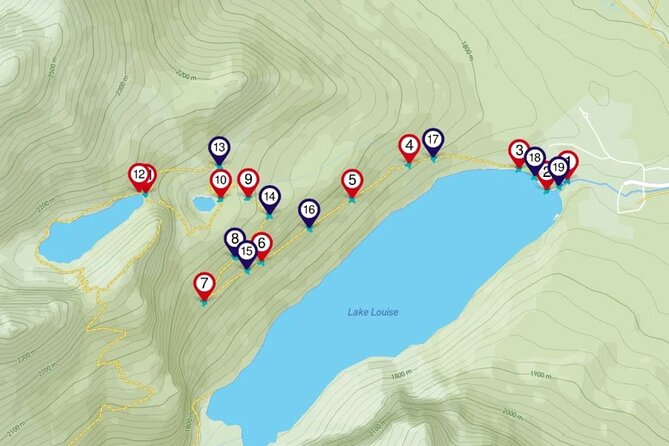
The best part of this experience is that it turns a famous Banff hike into a self-guided nature lesson. As you climb from Fairmont Chateau Lake Louise toward Mirror Lake and the Lake Agnes Tea House, audio commentary plays at points along the route, with facts about wildlife, plants, glaciers, Indigenous history, and mountain peaks.
I like the freedom to hike privately, with no group leader setting the pace. I also like the offline GPS and audio format, which lets you keep going when mobile service disappears. The main catch is the climb: the trail rises almost all the way, and the app has not worked perfectly for every user.
Key points to know before you go
- A 7-kilometre route: The walk follows the trail from Lake Louise to Mirror Lake and Lake Agnes Tea House, then returns to the starting area.
- Audio that works offline: Download the tour over Wi-Fi before setting out. No signal or mobile data is needed during the hike.
- Private and flexible: Only your own group takes part, and you choose the pace and rest stops.
- More than mountain views: Commentary covers Victoria Glacier, Banff National Park, wildlife, plants, Indigenous history, caves, and glacial melting.
- A steady uphill walk: The surface is fairly smooth for much of the route, but the climb is continuous and the final section is rockier.
- Good value at $8.22: The low price makes this a useful add-on for independent hikers, provided your phone and GPS behave properly.
What this Lake Agnes audio hike is really like
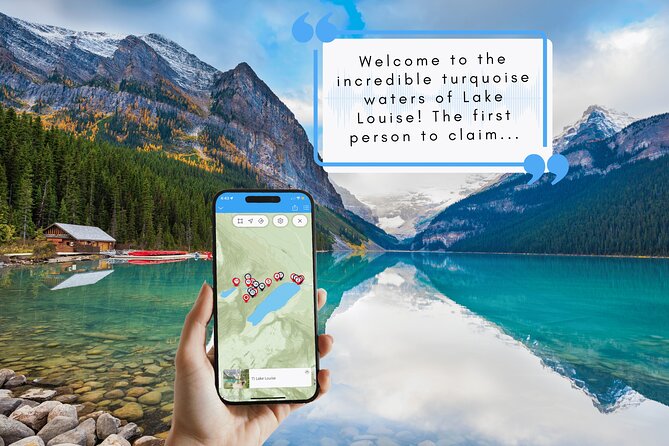
This is not a guided hike with a person walking beside you. It is a location-based audio tour that uses your smartphone, GPS, and a downloadable app. Once you reach each point of interest, the commentary should begin automatically.
You start at 111 Lake Louise Drive, near Fairmont Chateau Lake Louise. The route covers about 7 kilometres, takes roughly two to three hours, and finishes back near the starting point. The exact time depends on your pace, how often you stop, and how long you spend at Lake Agnes Tea House.
I see the format as a middle ground between hiking alone and joining a formal tour. You get structure and background information, but you can stop for photographs, wait for your group, or simply walk in silence whenever you wish. There is no fixed departure time listed beyond the broad operating period, which runs daily from midnight to 11:30 p.m. between February 16, 2021 and February 16, 2027.
The audio is in English. Trivia questions appear at the stops, but they are optional, so you can treat the tour as a quiet walk with occasional facts or as a small location game.
More walking routes in Alberta:
- Canadian Rockies: Private Helicopter Tour and Hike for Two
★ 5.0 · 7 reviews - Guided Glacier Hike on The Athabasca with IceWalks
★ 5.0 · 334 reviews - From Toronto: Algonquin Park Canoeing & Hiking Adventure
★ 4.6 · 291 reviews
Starting beside Lake Louise and Victoria Glacier
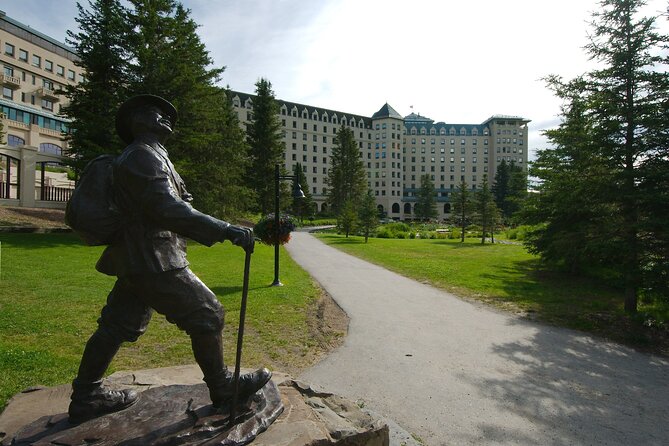
The first section begins near Fairmont Chateau Lake Louise, where the audio introduces the trail and the natural setting around you. This is a useful start because Lake Louise can feel like a place made for quick photographs. The commentary gives you reasons to pay attention beyond the postcard view.
Lake Louise is presented through its Stoney name, which means Lake of Little Fishes. As you continue along the route, the blue water appears through the trees and opens into a broad mountain-framed view. Victoria Glacier forms the high backdrop behind the lake, giving the scenery its most recognisable feature.
The audio also places the area within Banff National Park, founded in 1885. You hear about the park’s age, its plants, and its animals as you leave the lakefront and begin the climb. Those facts matter because the trail is not only a route to tea and a viewpoint. It crosses a living mountain environment with its own weather, forests, water, and wildlife.
The first part is also where you should set your expectations for the effort. The route is described as relatively smooth, but it is not flat. You gain height through a series of uphill sections and switchbacks, so a moderate fitness level is recommended.
Forest, wildlife, and the steady climb
As the trail rises, the forest becomes more prominent. The audio discusses Banff’s boreal biome and encourages you to notice how the trees change around you. You may find this more useful than a string of scenic facts because it gives you something specific to look for while walking.
The commentary also explains wildlife crossings in Banff National Park. You may have seen bridges or underpasses covered with trees and grass while driving through the area. These structures help animals cross roads more safely. The point is not a wildlife sighting guarantee, but it adds context to the park’s efforts to protect animals while roads carry traffic through the mountains.
The tour touches on the large variety of life in the region, including up to 310 bird species and 840 plant species. Those numbers make the forest feel less like background scenery and more like a place worth observing closely. Keep the phone accessible if you want to answer the trivia questions, but avoid letting the screen pull your attention away from the trail.
One audio stop discusses caves, including Castleguard Cave, even though you will not visit a cave on this route. This is a small example of the tour’s wider approach. Some commentary explains nearby or regional features rather than pointing only at something directly in front of you.
The hike’s physical demands deserve plain treatment. One user described it as a very challenging uphill walk, while another found the terrain fairly flat but noted that it rises all the way. Both observations can be true: the walking surface may feel manageable, yet the continuous incline can make the hike harder than the phrase moderate fitness level suggests.
Mirror Lake and Big Beehive Peak
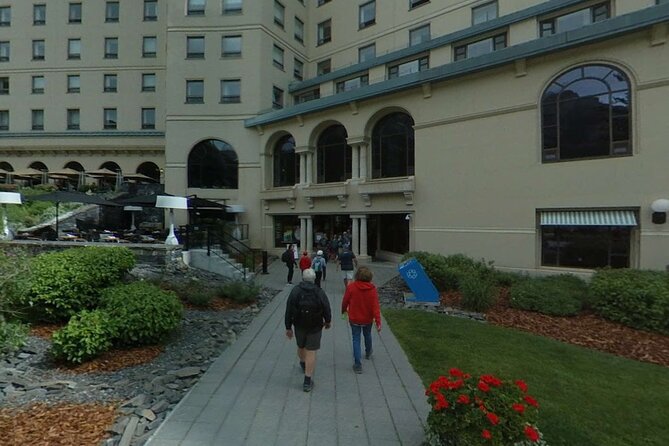
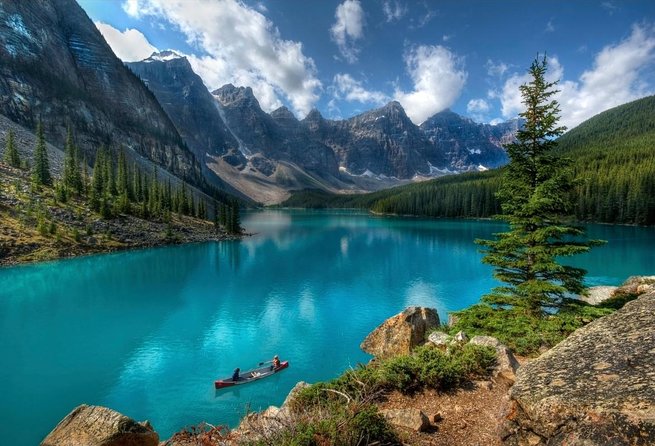
Mirror Lake is one of the clearest milestones on the way to the tea house. It is smaller than Lake Louise and gives you a more enclosed mountain view. Across the water, Big Beehive Peak provides the main visual marker.
This stop breaks up the climb. You can pause, look across the lake, and let the audio explain the peak and the area around it. If you are walking with a group, it is a sensible place to regroup before the final part of the ascent.
The app’s automatic playback is meant to make these pauses easy. When you approach a point of interest, the commentary should start through your phone. You can also use the live GPS map to check your location and see where to go next.
That convenience has a limitation. The audio did not play smoothly for everyone. One person found it kicked in and out and had to adjust the phone repeatedly. Another said the app failed altogether, despite enjoying the hike and views. The provider explains that GPS signals can cause irregular playback on some devices and suggests playing the audio manually if needed.
I would treat the app as a helpful extra, not as the thing that makes the hike possible. Download the tour before you leave Wi-Fi, check that the route and audio are available, and be ready to start a track manually. The trail itself does not depend on the commentary.
Same base, a different sort of day:
- Wild Water Adventures
★ 5.0 · 581 reviews - Moraine Lake, Lake Louise Johnston Canyon Banff National Park
★ 4.5 · 243 reviews - Icefields Parkway: a Smartphone Audio Driving Tour
★ 4.0 · 118 reviews - Lake Louise Summer Gondola Experience
★ 4.0 · 65 reviews
The final climb to Lake Agnes Tea House
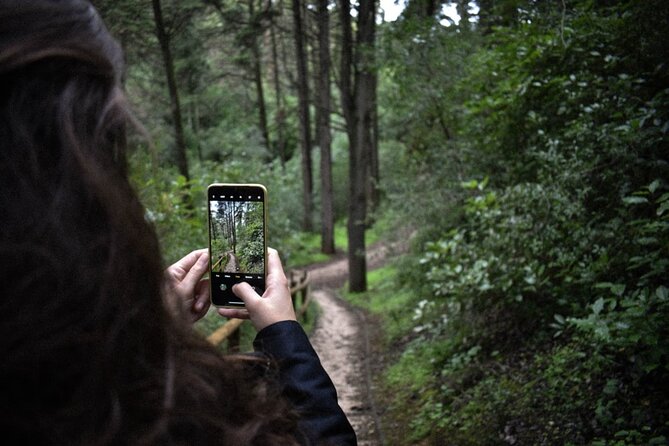
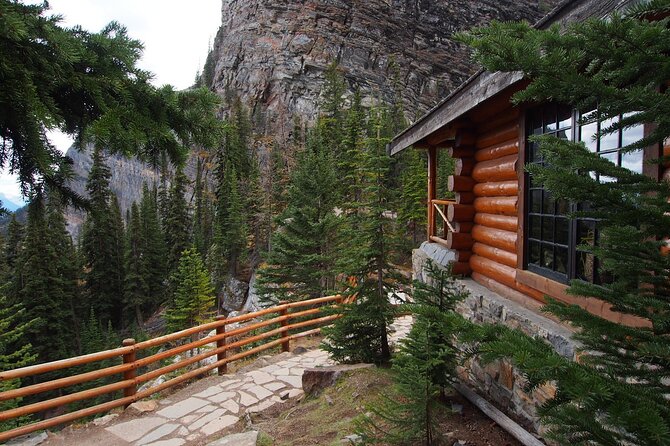
After Mirror Lake, the trail continues uphill toward Lake Agnes. The final ascent includes wooden stairs and waterfall views. This section feels more demanding, especially if you have already spent much of the walk climbing.
The audio connects the route with early explorers and explains how the Lake Agnes Tea House came to be named. The building is the destination most people have in mind when they choose this hike, but the approach is part of the reward. The sound of water, the stairs, and the changing mountain views give the final section a clear sense of progress.
At Lake Agnes, you reach an elevation of about 7,005 feet. The lake sits in a high mountain setting, with Mount St. Piran visible to the right. The tour points out the option of continuing farther for those who still have energy, but the supplied route focuses on the tea house and lake area.
You should not confuse this with an easy walk to a café. The tea house is reached only after a sustained uphill hike, and the return trip still lies ahead. The experience suits people who want the destination but also accept that the climb is the main event.
The return route and wider mountain context
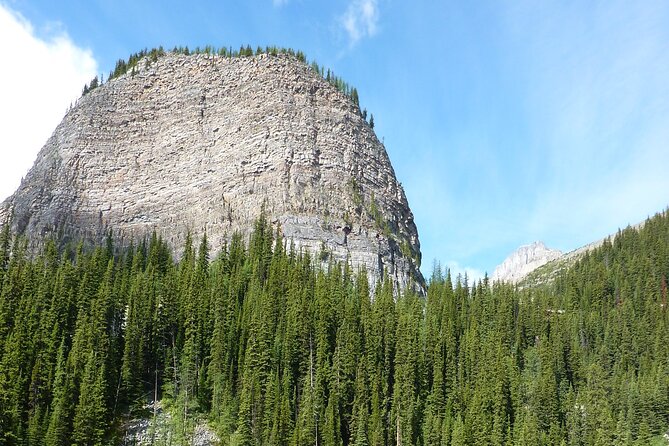
The commentary continues on the way back rather than ending at Lake Agnes. It points out different mountain peaks and asks you to notice how they look from changing angles. This is a good use of the return journey, when the scenery can otherwise feel familiar.
Other stops discuss Castle Mountain, a distinctive formation visible near the Lake Louise exit from the Trans-Canada Highway. You will not necessarily have the same view from every point on the trail, but the audio ties the hike to the wider Banff area.
The tour also gives attention to Indigenous history. Evidence of human presence in Banff National Park reaches back as far as 10,000 years, long before the arrival of the explorers and infrastructure often highlighted in park stories. This is important context, especially in a place where visitors can easily focus only on glaciers, peaks, and famous hotels.
Near Lake Louise, the audio explains how the lake responds to glacial melting and winter cold. That adds a useful final layer to the scenery. The water is not just a striking colour in a photograph. It is part of a system shaped by ice, temperature, and mountain runoff.
How the app works on the trail
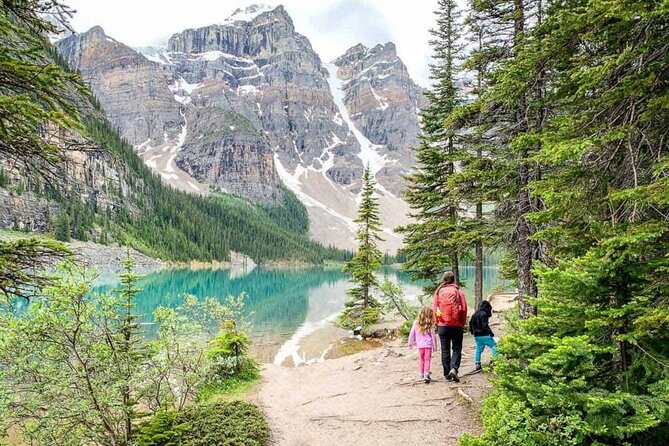
You receive the tour through the Tripvia Tours app. Download it over Wi-Fi before starting. Once it is on your device, the tour can be used without a phone signal and without using mobile data during the walk.
The live GPS map shows your position and the next part of the route. Location-triggered commentary should play when you reach the relevant points. Trivia questions are available at each stop, and you tap your answer on the device if you want to play.
Bring your own smartphone or tablet. Neither is included. Headphones are also not provided, though they are optional because the audio can play through the device speaker.
There is a practical detail worth noting when booking for several people. The number of people selected equals the number of devices that can download the tour. The activity itself is private, so your whole group can walk together, but each additional device must be covered through the booking selection.
If the phone battery is low, the audio will not help much, so charge your device before you go. That is ordinary hiking preparation, but it matters more here because the phone is both your guide and your map.
Is $8.22 good value?
At $8.22 per person, this is inexpensive for a two to three-hour route through one of Banff’s best-known hiking areas. You are paying for interpretation, GPS guidance, trivia, and the option to keep the tour in the app for future use. You are not paying for transport, a person-led hike, food, equipment, or admission to a separate attraction.
The value is strongest if you want to walk independently but would enjoy more context than a printed trail sign provides. The price is also easy to justify for a private group, since you avoid the cost and restrictions of a formal guided outing.
The value is weaker if you expect flawless automatic playback or a live guide who can answer questions. The app problem reported by one user is a real consideration, even though another person said it worked well and felt like helpful company along the route.
The free cancellation policy helps reduce the risk. You can cancel for a full refund at least 24 hours before the start time. Cancellations or changes inside that window are not refunded or accepted.
Who should choose this experience?
I would choose this audio tour if you want:
- A self-paced walk with more explanation than the trail alone provides
- A private outing for your own group
- Offline access in an area where signal may not be available
- Nature facts, history, and optional trivia
- A low-cost alternative to a live guided hike
- A flexible route that does not force you to stay with strangers
I would think twice if you have health problems that make a continuous uphill hike unsuitable. The physical effort is the main issue, not the trail’s technical difficulty. The surface is fairly smooth in places, but the route becomes rockier near the end and keeps climbing for much of the way.
The tour is offered in English only. If you need another language, the audio may not meet your needs. Service animals are allowed, but the experience still requires a moderate level of physical fitness.
Should you book the Lake Agnes audio tour?
Book it if you want the Lake Agnes Tea House Trail on your own terms and would value a steady stream of nature and park information along the way. The price is low, the route is private, and the offline map is useful in a mountain area where phone service may not be dependable.
Do not book it as a substitute for hiking preparation or a live guide. Plan for a sustained uphill walk, download everything before leaving Wi-Fi, and keep manual playback in mind in case the GPS triggers are uneven. For an independent hiker who accepts those limits, this is a practical way to add meaning to one of Lake Louise’s classic walks.
FAQ
How long is the Lake Agnes Tea House audio tour?
The route is about 7 kilometres and takes approximately two to three hours.
Where does the tour start?
It starts at 111 Lake Louise Drive, Lake Louise, Alberta, near Fairmont Chateau Lake Louise.
Where does the activity finish?
The activity ends back at the meeting point.
Is this a private tour?
Yes. Only your own group participates, and no other groups join your activity.
Do I need mobile service during the hike?
No. Download the tour over Wi-Fi before you go. The app can then be used without a signal or mobile data.
Is a smartphone included?
No. You must bring your own smartphone or tablet.
Are headphones provided?
No. Headphones are not provided, but they are optional because the audio can play through your device speaker.
What language is the audio offered in?
The tour is offered in English.
Is the hike physically difficult?
A moderate level of physical fitness is recommended. The trail rises almost all the way, and the final section is rockier. It may not suit people with health problems that make uphill walking difficult.
What happens if I need to cancel?
You can receive a full refund if you cancel at least 24 hours before the experience start time. Cancellations or changes made less than 24 hours before the start time are not refunded or accepted.
Just added in Alberta
- Smartphone Audio Driving Tour between Lake Louise and Calgary★ 4.0 · 15 reviews
- Official SkiByk Rentals in Banff & The Canadian Rockies★ 5.0 · 9 reviews
- Moraine Lake and Lake Louise Sightseeing Half Day Tour★ 5.0 · 23 reviews
- Icefields Parkway: a Smartphone Audio Driving Tour★ 4.0 · 118 reviews
- Lake Louise to Jasper One-Way Tour★ 5.0 · 17 reviews
- Airport Shuttle: Lake Louise <---> Calgary★ 5.0 · 4 reviews
- Lake Louise Summer Gondola Experience★ 4.0 · 65 reviews
- Lake Louise to Calgary YYC Airport – Private Shuttle★ 5.0 · 5 reviews
Hiking & Trekking, compared.
Guided Glacier Hike on The Athabasca with IceWalks
Read our review →
Wildlife and Waterfalls Tour with Lakeshore Hike
Read our review →
Jasper Wildlife and Sightseeing Tour with Maligne Lake Hike
Read our review →
Browse the lists this tour appears in