
Reviewed · HISTORICAL TOURS
Half-Day Historical Tour of Halifax
Halifax’s past is unusually concentrated: Titanic victims, a catastrophic 1917 explosion, British military power, immigration, shipping, and Acadian history all meet within a few miles. Paul McNeil’s six-hour tour covers that story by van, with stops in Halifax, Dartmouth, and Fisherman’s Cove. His tablet videos and photographs add useful context when a building or cemetery alone cannot tell the full tale.
I like the small maximum of 10 people, which makes hotel pickup and questions easier than on a large coach. I also like the mix of major sights and less obvious stops, from the Mont Blanc anchor to Mount Olivet Cemetery and the Hydrostone district. The main caution is pace: you see a great deal, but some stops are brief, and cruise passengers with a tight departure time may not complete every section.
Key points at a glance

- Paul McNeil’s history-first presentation: Expect detailed commentary, photographs, short videos, and a strong focus on Titanic and Halifax Explosion stories.
- A true Halifax and Dartmouth circuit: The route crosses the harbour and includes Fisherman’s Cove, Lake Banook, cemeteries, memorials, and waterfront sites.
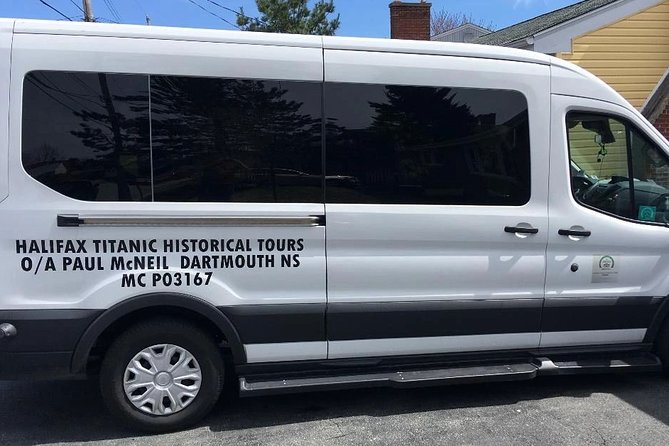
- Small-group transport: The Ford Transit van carries four to ten people, with air conditioning, bottled water, and WiFi.
- A noon Citadel arrival: The schedule is designed to reach Halifax Citadel for the traditional noon gun and the 78th Highlanders’ guard ceremony.
- Mostly short walks: You spend substantial time in the van, with outings at the Public Gardens, cemeteries, Fisherman’s Cove, and selected landmarks.
- Lunch is optional and extra: The Dartmouth stop at Evan’s Seafood allows time for a Nova Scotia seafood meal, but food and drinks are not included.
Halifax’s story begins at the waterfront
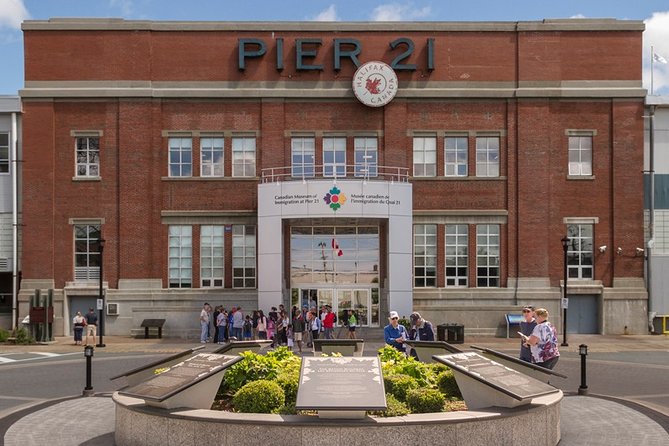
The tour starts at Pier 21, the former immigration gateway often called the Gateway to Canada. This is a fitting place to begin because Halifax is not just a military port. It is also a city shaped by arrivals, departures, ocean trade, and families separated by long voyages.
Near the waterfront, you hear about the Halifax Seaport Farmers’ Market. Created by royal proclamation in 1750, the market has occupied several sites before moving to the Seaport in 2010. Its long history connects today’s food stalls with the old meat, produce, and livestock market supplied by Acadian farms and local producers.
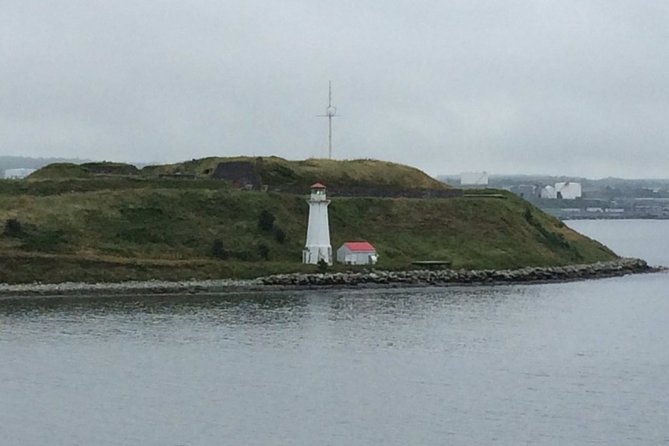
The waterfront route also brings in Sir Samuel Cunard, the Halifax-born shipping leader who founded the Cunard Line. You pass the long downtown boardwalk beside one of the world’s largest natural harbours, then hear about Georges Island, Fort Charlotte, British defence plans, and the island’s role as a holding area for Acadians during the deportation period from 1755 to 1763.
These details help you see Halifax as more than a pretty harbour city. Its waterfront carries stories of empire, migration, military control, and loss.
A few more things to do in Halifax worth a look
- Peggy’s Cove & Halifax Historic Tour
★ 4.5 · 375 reviews - Victoria Guided Food and History Tour
★ 5.0 · 2,015 reviews - Gastown Historic Walking Food Tour
★ 5.0 · 1,863 reviews
Historic buildings packed into downtown

The central Halifax portion moves through a dense group of churches, public buildings, cemeteries, and restored warehouses. You hear about Alexander Keith and his brewery, one of North America’s oldest working breweries. You also see HMCS Sackville, the only surviving Allied corvette from the Second World War, now Canada’s Naval Memorial.
The Maritime Museum of the Atlantic is recommended as a separate visit before or after the tour. Its subjects include sailing ships, steam, wartime convoys, Titanic, and the Halifax Explosion. The tour cannot give you the same museum time, but it helps you decide what deserves a longer visit later.
You also hear about Nova Scotian folk artist Maud Lewis and see several architectural landmarks:
- Historic Properties, a restored group of waterfront warehouses dating from the late 1700s and early 1800s.
- Saint George’s Round Church, a wooden Palladian-style church built in 1800.
- Saint Paul’s Church, founded in 1749 and described as the first Anglican cathedral built outside England.
- Halifax City Hall, built between 1887 and 1890.
- Province House, Canada’s oldest legislative building and home of the first elected House of Assembly.
- Government House, the oldest official residence in Canada.
- Saint Mary’s Cathedral Basilica and the Halifax Court House.
- The modern central library, whose design resembles a stack of books.
This is a lot of architecture in a short time. I would not expect long interior visits at each site. The value is in seeing how Halifax’s government, religion, commerce, and public life developed side by side.
Cemeteries tell Halifax’s harder stories
Halifax’s old cemeteries are not filler stops. They are essential to understanding the city.
The Old Burying Ground contains more than 1,200 headstones and footstones from the 18th and early 19th centuries. Camp Hill Cemetery replaced it in 1844 and includes the graves of Viola Desmond, Alexander Keith, Joseph Howe, and Titanic survivor Hilda Mary Slayter.
Fort Massey Cemetery contains British and Canadian military graves, while Holy Cross Cemetery holds around 25,000 people, many of Irish descent. At Holy Cross, you see Our Lady of Sorrows Chapel, a small building said to have been constructed in one day in 1843. Its French stained glass dates from the 16th and 17th centuries.
All Saints Cathedral adds another Titanic connection. It was the site of the first Titanic funeral for William Henry Harrison, Bruce Ismay’s private secretary.
These stops suit you if you like history told through individual lives. They may feel less satisfying if you prefer long walks, photo time, or extended museum visits. The guide does most of the storytelling while you move between sites.
The Citadel and the noon gun
The timing at Halifax Citadel is one of the tour’s strongest features. The route aims to arrive for the noon gun, a Halifax tradition dating to 1856, followed by the changing of the guard involving the 78th Highlanders.
The present Citadel, officially Fort George, was completed in 1856. Its star-shaped design, deep ditch, ramparts, and wide firing arcs show why the fort controlled the city without ever needing to fight off an attacking force.
The scheduled visit here is about 15 minutes, and admission is not included. That means you should think of this as an outdoor orientation and ceremony stop, not a full Citadel visit. If you want the barracks, exhibits, tunnels, and longer fort exploration, plan separate time and budget for admission.
The Old Town Clock follows naturally. Prince Edward, Duke of Kent, arranged for its turret clock in 1800 to reduce tardiness among the British garrison. It remains one of Halifax’s most recognizable reminders of the city’s military past.
Same base, a different sort of day:
- Halifax Harbour Hopper Tour
★ 4.5 · 1,296 reviews - Halifax Peggy’s Cove Express
★ 4.0 · 801 reviews - Wine and Lunch Escape
★ 5.0 · 562 reviews - Halifax Small-Group Express Peggy’s Cove Tour
★ 4.5 · 544 reviews
Gardens, parks, and the edge of the city

The Halifax Public Gardens provide the tour’s most relaxed walk. This 17-acre Victorian garden has ornamental gates, a wrought-iron fence, fountains, statues, trees, and seasonal plantings. You have about 30 minutes here, enough for a pleasant stroll and photographs, though not enough for an unhurried visit to every corner.
Point Pleasant Park gives you another view of Halifax. Its 75 hectares contain wooded paths, coastal areas, and old fortification ruins. The city leases the park from the British government for one shilling a year under a 999-year lease, a wonderfully odd detail that brings local history down to earth.
The route also passes Dalhousie University and the University of King’s College. Dalhousie dates to 1818, while King’s College was established in 1789 and is Canada’s oldest chartered university.
At Sir Sandford Fleming Park, known as The Dingle, you see a tower donated by Fleming, the creator of standard time zones. It was dedicated in 1912 to mark 150 years of representative government. This stop is short, around 10 minutes, so expect a view and explanation rather than a full park visit.
Titanic graves and the Halifax Explosion

The tour’s most moving section covers Titanic victims and the Halifax Explosion of December 6, 1917.
At Mount Olivet Cemetery, you see markers for 19 Roman Catholic Titanic victims and hear about Margaret Rice, the Halifax Explosion’s miracle child known as Ashpan Annie, and Vincent Coleman, remembered as a hero of the blast.
Fairview Lawn Cemetery contains 121 Titanic victims. The stories of J. Dawson and Sidney Leslie Goodwin give a human face to the disaster, while the cemetery also includes unidentified victims of the Halifax Explosion.
The connection between Halifax and Titanic is often reduced to a few famous facts. This tour gives you the burial places and names, which makes the event feel less like a distant shipwreck and more like a local tragedy.
The Halifax Explosion Memorial Bell Tower on Fort Needham overlooks the area damaged by the blast. The explosion killed about 1,900 to 2,000 people, injured 9,000, and left 25,000 homeless. The memorial honours those killed, injured, or displaced, as well as the people who rebuilt Halifax and Dartmouth.
You also see the Mont Blanc anchor shaft, a 1,140-pound piece thrown roughly 2.3 miles by the explosion. Another recovered cannon was hurled nearly three miles to Albro Lake in Dartmouth. These objects make the force of the blast easier to grasp than numbers alone.
The Hydrostone district shows what came next. After wooden buildings collapsed onto stoves and furnaces, reconstruction planners turned to fire-resistant concrete blocks finished with crushed granite. The result is a distinctive neighbourhood built with safety as a central concern.
Across the harbour to Dartmouth
The Dartmouth section changes the rhythm. You see Lake Banook, a freshwater lake associated with canoeing, kayaking, rowing, and dragon boating. It also has a local claim to the birthplace of ice hockey.
Lunch at Evan’s Seafood is optional and not included in the tour price. Orders are phoned ahead, which helps keep the 30-minute stop moving. You can order fresh Nova Scotia seafood, including gluten-free options, while looking back toward Halifax.
This is a practical stop, but lunch quality and preferences are personal. If you want a specific restaurant or a longer meal, this schedule may feel restrictive. The tour is built to cover a lot of ground, not to create a leisurely food outing.
Fisherman’s Cove closes the loop with a restored 200-year-old working fishing village. Its colourful buildings and waterfront setting make it one of the easiest places on the route for photographs. It also gives you a glimpse of coastal life beyond downtown streets and formal monuments.
What the six hours feel like

The van is a Ford Transit 350 XLT High Roof with room for up to 10 people. The high roof makes getting in and out easier, a useful feature if stairs or low vehicle doors are uncomfortable. Bottled water and WiFi are provided.
You should expect a driving-heavy day with several short walks. Stops include the Public Gardens, Citadel, cemeteries, memorials, lunch, and Fisherman’s Cove, but many landmarks are explained from the vehicle. One guest found the amount of van time greater than expected, while another specifically valued the tour for requiring limited walking.
The mounted tablet is a real advantage. Paul uses images, video clips, and presentation material to show places or events that cannot be understood from the roadside. His detailed approach suits you if you like dates, names, military history, disasters, and connections between places.
Seating goes to the first confirmed bookings, so early booking matters if you care about your position in the van. Pickup is available from downtown hotels and the cruise port, or you can meet at Pier 22, 1041 Marginal Road. All-day parking there costs $10 CAD.
The tour runs Monday through Sunday, generally between 8:00 and 11:30 in the morning for departure times. Confirmation arrives when you book, and at least four people are required for the tour to operate. Service animals are allowed, and most people can take part, but you should discuss particular mobility needs before booking.
Is $131.43 good value?
At $131.43 per person, this costs more than a basic city sightseeing ride. You are paying for a six-hour private-style format, a small group, hotel or port pickup, transport across the harbour, and a guide who handles the driving while giving extended historical commentary.
The value is strongest if you have only one day in Halifax, want Titanic and Explosion sites, or prefer not to organize several outlying locations yourself. It is also useful on a cruise stop, provided your ship schedule allows plenty of return time.
The price does not include lunch, alcohol, Citadel admission, or gratuity. Those extras are easy to account for, but the bigger cost is time. If you want to spend an hour inside the Maritime Museum, wander Point Pleasant Park, or explore the Citadel in detail, you will need to do that separately.
Paul McNeil receives especially strong praise for organization, local detail, multimedia explanations, and personal attention. His approach is earnest and packed with information. I would choose this tour for learning, not for a quiet scenic drive.
Should you book it?
Book this tour if you want Halifax’s major historic themes tied together in one day: immigration, shipping, military defence, Titanic, the Halifax Explosion, cemeteries, churches, and Dartmouth’s waterfront. It is a particularly good fit for first-time visitors, cruise passengers with a workable port schedule, history fans, and people who cannot walk long distances.
Think twice if you want lots of free time, a museum visit included, a relaxed lunch, or a social outing with minimal narration. Also contact the operator before booking if your ship leaves early. One cruise passenger reached the ship in time but missed Fisherman’s Cove and part of Dartmouth because the tour had to be shortened.
For most people seeking the broad Halifax story in a single outing, the tour earns its price through coverage and local detail. Just treat the six hours as an ambitious overview, not a series of long site visits.
FAQ
How long is the Halifax historical tour?
The tour lasts approximately six hours.
What is the maximum group size?
The tour has a maximum of 10 people and requires at least four participants to operate.
Who leads the tour?
The guide is Paul McNeil of Halifax Titanic Historical Tours.
Where does the tour begin?
You can meet at Pier 22 parking lot, 1041 Marginal Road, Halifax, Nova Scotia. Pickup is also offered from listed downtown hotels.
Does the tour include Dartmouth and Fisherman’s Cove?
Yes. The route includes Dartmouth, Lake Banook, Evan’s Seafood, and Fisherman’s Cove, along with many Halifax sights.
Is lunch included?
No. Lunch is not included. The tour stops at Evan’s Seafood, where you may order fresh Nova Scotia seafood, including gluten-free choices.
Is admission to the Halifax Citadel included?
No. Admission to the Halifax Citadel is not included.
Can I cancel for a full refund?
You can cancel at least 24 hours before the start time for a full refund. Cancellations or changes made within 24 hours are not refunded, and poor weather or failure to reach the minimum group size may lead to another date, an alternate experience, or a full refund.
Just added in Halifax
- Private Wine Tours from Halifax★ 5.0 · 24 reviews
- Afternoon Escape Wine Tour★ 5.0 · 23 reviews
- Halifax Boardwalk & Seaport: a Smartphone Audio Walking Tour★ 4.0 · 19 reviews
- JFarwell Sunset Wine and Cheese Yacht Sailing★ 5.0 · 149 reviews
- Halifax Churches, Gardens & Graveyards: a Smartphone Audio Walking Tour★ 4.5 · 25 reviews
- Halifax Harbourfront Small Group Food Walking Tour★ 4.5 · 63 reviews
- Halifax Segway City Spin★ 5.0 · 145 reviews
- Halifax Walking Food Tour★ 5.0 · 40 reviews
Historical Tours, compared.




Evening Gourmet Tour 5 Course Dinner – History and Food in Old Quebec City
Read our review →


Browse the lists this tour appears in