
Reviewed · CAPILANO SUSPENSION BRIDGE & GROUSE MOUNTAIN
Whistler Train Wreck, Suspension Bridge & Hidden Waterfall Adventure
Whistler’s Train Wreck is one of those odd local sights that sounds unimpressive until you see it: battered railway boxcars scattered among towering cedar trees, their rusted sides covered in colorful graffiti. Add a forest trail, glacial water, and a suspension bridge, and you have a short outing with more character than a standard sightseeing walk.
I like the way this tour pairs two very different stops: the graffiti-covered boxcars and the Cheakamus River. I also like the small maximum group of 10, which gives your guide room to explain the area and adjust the pace. The main consideration is physical effort. You need sturdy enclosed shoes and enough fitness for uneven, undulating ground.
- Train cars in the forest: See the remains of a 1950s railway crash, now painted by local artists.
- Two contrasting stops: Spend about an hour at the Train Wreck Trail and another hour around the Cheakamus River.
- Suspension bridge views: Look down at turquoise glacial water from above the river.
- Small-group format: The group is limited to 10 people, with more opportunity to speak with your guide.
- Easy central meeting point: Begin and finish at the Gondola Transit Exchange in Whistler.
- Short but active outing: The tour lasts about two hours, but the uneven trail requires proper footwear.
Why Whistler’s Train Wreck Is Worth Your Morning
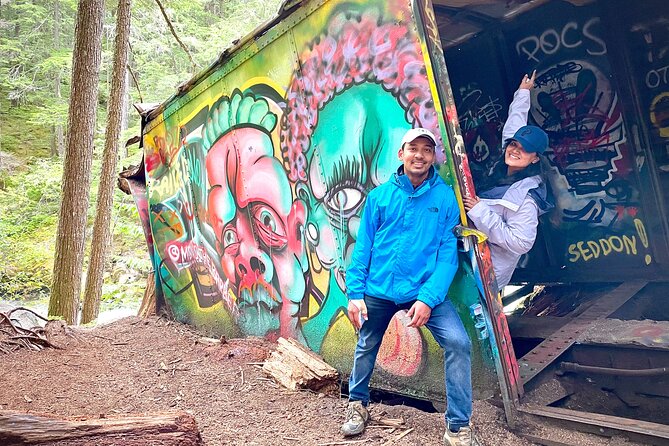
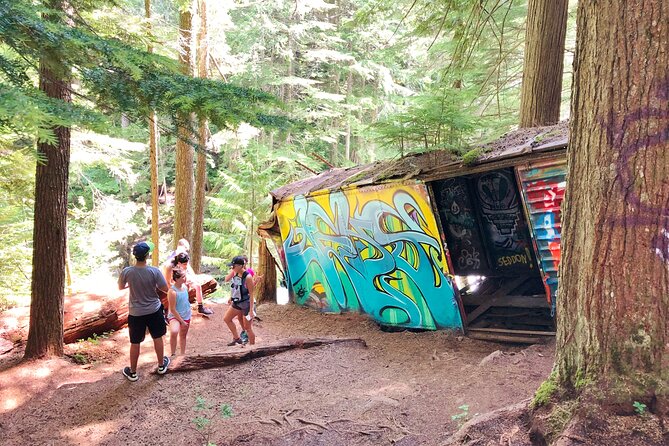
The Train Wreck Trail offers a memorable contrast. On one side, you have a temperate rain forest with cedar trees and glacial water. On the other, you have old railway boxcars marked with layers of bold graffiti. It is not a polished museum or a restored heritage site. The appeal comes from seeing an industrial accident gradually absorbed into the forest.
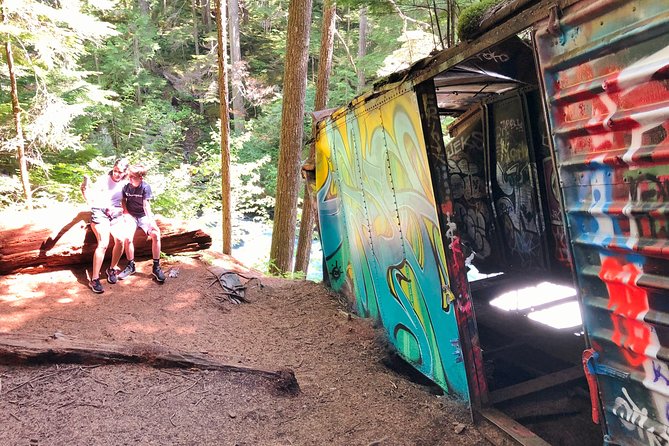
The wreck dates from the 1950s. The cars were left behind after the crash, and local artists later turned their steel walls into large outdoor canvases. The artwork gives the site an unusual feel: part railway relic, part forest walk, and part informal art display.
I like this kind of stop because it gives you something to look at from several angles. You can study the paint, the shape of the damaged cars, and the way the trees and surrounding water frame the scene. It also makes for strong photographs without requiring a long day on the trail.
The boxcars are not the only reason to go. The setting matters just as much. The contrast between hard metal and thick forest makes the visit feel specific to Whistler rather than interchangeable with any short woodland walk.
The First Hour: Walking to the Train Wreck
The first part of the outing is devoted to the Whistler Train Wreck Trail, with about one hour allocated to this stop. You will walk over undulating terrain, so this is not a flat pavement stroll. The route calls for sturdy enclosed footwear, and that advice should be taken seriously.
The supplied details do not give a trail distance or elevation figure, so you should not plan around a precise mileage target. Instead, think of it as a short guided hike that requires steady footing. If you are comfortable walking on uneven ground, the physical demand should be manageable. If you prefer smooth, level paths, this may feel more strenuous than the two-hour duration suggests.
A guide adds value here because the wreck is more interesting when you understand what you are seeing. The cars are not simply old objects placed beside a trail. They are remnants of a railway crash from the 1950s, later marked by local artists. That background helps connect the site’s present-day art to its earlier industrial use.
Ryan is one of the guides associated with this experience. If he leads your outing, you can expect the kind of local explanation that helps place the wreck and surrounding area in context. One particularly useful feature of a small group is the chance to ask questions without trying to compete with a large crowd.
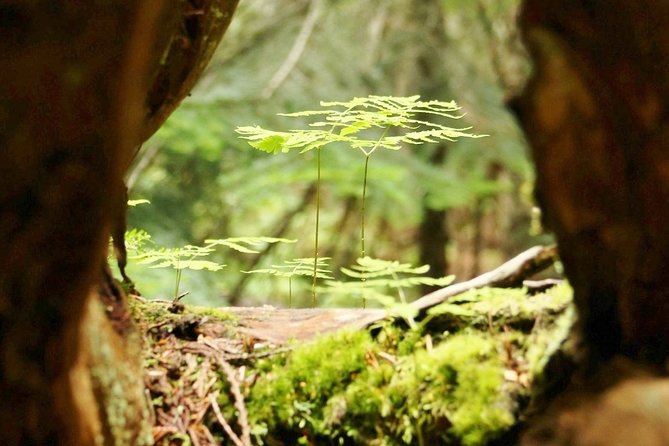
You should also allow time to look beyond the boxcars. The trail passes through temperate rain forest, with towering cedars above and glacial waters nearby. The most interesting moments may come from the full scene rather than any single painted car.
Other north shore days out of Whistler:
- Vancouver: Capilano Suspension Bridge Park Ticket
★ 4.7 · 2,181 reviews - Capilano Suspension Bridge Park Ticket
★ 4.5 · 1,814 reviews - Vancouver Tour: Stanley Park, Granville Island & Capilano Bridge
★ 4.5 · 1,778 reviews
Graffiti, Rust, and Cedar Trees
The artwork is the visual hook, but it is worth arriving with realistic expectations. This is not a formal gallery with labels, barriers, or a fixed exhibition. The graffiti is painted directly across the boxcars, and the setting gives the art its force.
The paint creates a strong contrast with the natural surroundings. Bright colors break up the weathered metal, while the trees and water provide a quieter backdrop. You can spend time comparing the different cars and taking in how the art has changed the feel of the abandoned railway equipment.
I would not choose this tour solely for the graffiti if you want a carefully organized art program. Choose it if you like unusual places, outdoor photography, and local sites that have developed their own character over time. The experience is strongest when you treat the wreck as part of a larger forest setting.
The trail also gives you a tangible connection to the area’s past. You are not only looking at scenery from a viewpoint. You are seeing an object that has remained in place and now shares space with the forest. That combination gives the walk a welcome sense of discovery without requiring a full-day excursion.
The Second Hour: Cheakamus River and Suspension Bridge
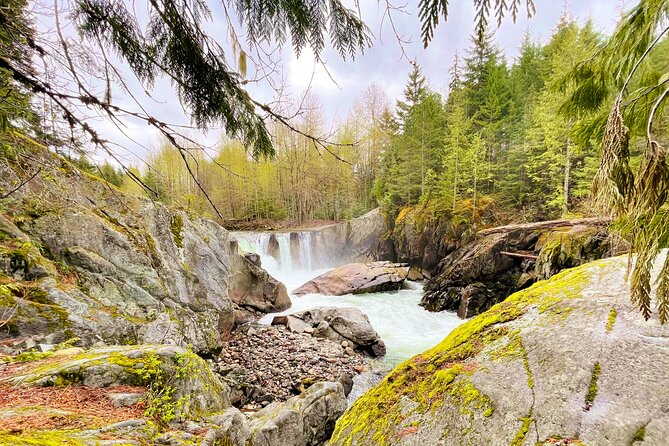
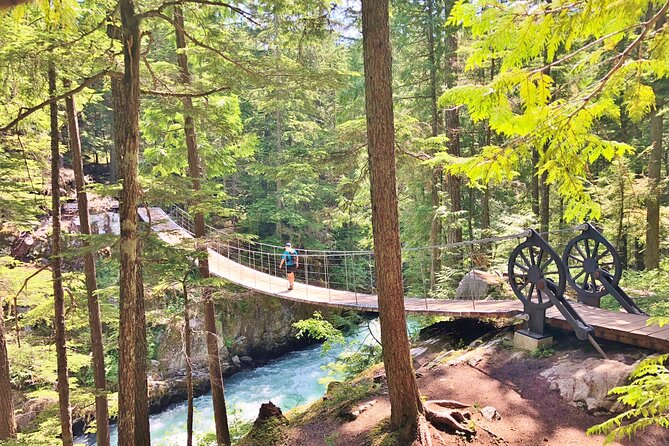
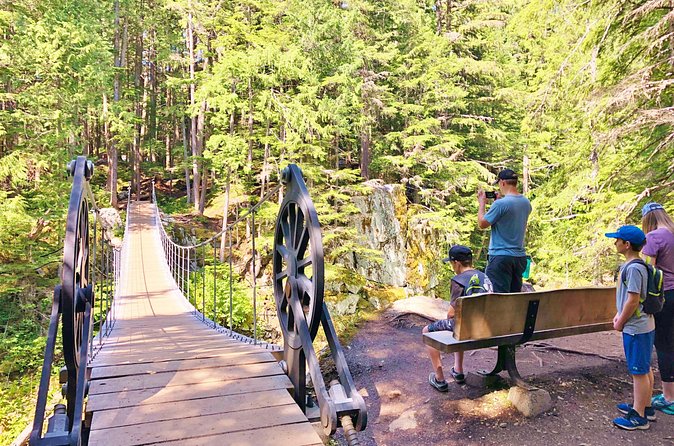
The second stop shifts the focus from railway remains to moving water. The Cheakamus River is described as a glacial stream that runs through narrow canyons and past waterfalls. The key view comes from the Cheakamus Suspension Bridge, where you can look down at the turquoise water from above.
This is a good counterpoint to the Train Wreck Trail. The first stop is close-up and textured, with metal, paint, and trees. The river stop opens the view and gives you a chance to appreciate the scale of the surrounding natural setting.
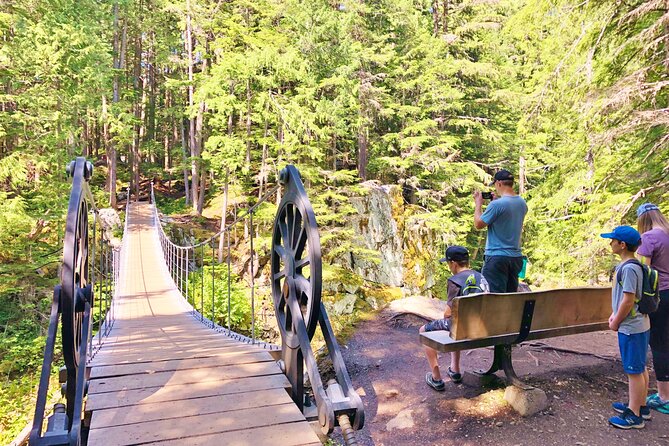
The bridge itself is part of the attraction, not just a route between two points. Crossing a suspension bridge adds a little movement and height to the walk, while the water below supplies the strongest visual feature. If you enjoy river views, this portion may be your favorite.
The information provided does not specify the bridge’s length, height, or whether it moves noticeably underfoot. It is best to think of it as a scenic crossing rather than a major thrill ride. You will be above the river, with views of turquoise glacial water, narrow canyon sections, and nearby waterfalls.
The waterfall element is important, but you should keep your expectations measured. The tour describes views of waterfalls along the river rather than a specific waterfall reached at the end of a separate hike. You may find the best views depend on the exact point along the route and the conditions that day.
A Two-Hour Tour That Uses Time Well
At approximately two hours, this outing fits neatly into a Whistler morning. The scheduled start is 9:30 am, and the group returns to the Gondola Transit Exchange at the end. That central start and finish make planning easier, especially if you are staying near Whistler’s main activity area or connecting the tour with another part of your day.
The timing also keeps the experience focused. You are not committing to a half-day hike, yet you still get two distinct places. About one hour is set aside for the Train Wreck Trail and about one hour for the Cheakamus River.
That short format has both strengths and limits. I like it for a first visit to Whistler, a free morning, or a day when you want outdoor scenery without giving up the rest of your schedule. On the other hand, anyone hoping for a long, slow forest hike may find the pace too compact.
A small group can make the time feel more useful. With no more than 10 people, your guide can provide attention and answer questions. The experience may be especially good for solo participants or couples who prefer a personal outing instead of joining a large bus group.
One person may even have the guide’s full attention if the departure happens to be lightly booked. That possibility is reflected in the way Ryan has been praised for his helpful approach and area knowledge. Group size can vary, but the maximum is clearly limited to 10.
Other trips by rail from Whistler:
- Niagara Parks: Power Pass + Falls Incline Railway
★ 4.7 · 164 reviews - Bicyle Tour on Historical Kettle Valley Railway from Myra Canyon to Penticton
★ 5.0 · 62 reviews - Guided Bike Tour on Historical Kettle Valley Railway at Myra Canyon & Wine Tour
★ 5.0 · 19 reviews
What the Price Includes in Practical Terms
The cost is $116.44 per person. That is not the cheapest way to take a walk in Whistler, since the natural setting itself is free to admire once you reach it. The question is what you are paying for beyond access to the trail.
You are paying for a guided small-group outing, a planned visit to two separate sights, and the convenience of beginning and ending at the Gondola Transit Exchange. Admission to both listed stops is included. You also receive a mobile ticket, which keeps the booking simple.
The value is strongest if you want context and structure. A guide can explain the Train Wreck’s background, help you make sense of the area, and keep the morning moving from the forest trail to the river. You are also spared the uncertainty of trying to organize both stops on your own.
The price is harder to justify if you already know the area well, prefer walking alone, or want a longer hike for the same amount of time. This is a compact guided experience, not a full-day wilderness outing. I would see it as a good value for visitors who want an accessible introduction to two distinctive Whistler sights.
Who Will Enjoy This Outing Most
This tour suits you if you like a mix of natural scenery and unusual local history. The Train Wreck is more interesting for people who enjoy places with visible layers of use and change, while the river and bridge appeal to anyone who wants forest and water views.
It is also a sensible choice for:
- First-time visitors who want a short introduction to the area
- Couples or solo visitors who prefer a small group
- People interested in outdoor art and industrial remnants
- Anyone with a free morning before another Whistler activity
- Hikers comfortable with uneven, undulating paths
- Visitors who want a guide rather than a self-guided walk
You should think twice if you need a fully accessible route, dislike suspension bridges, or are looking for a strenuous all-day hike. The physical requirement is listed as moderate fitness, and enclosed sturdy footwear is mandatory.
Service animals are allowed, and the activity is near public transportation. It is offered in English. Those details may matter if you are building a day around public transit or need to confirm language and service-animal arrangements before booking.
Weather, Cancellations, and Planning Ahead
The experience requires good weather. If poor weather causes a cancellation, you are offered another date or a full refund. The same applies if the minimum number needed to run the tour is not met.
For your own booking, the key rule is the 24-hour cancellation deadline. You can cancel at least 24 hours before the local start time for a full refund. Cancellations or changes made less than 24 hours before the start are not refunded or accepted.
The activity is often booked well ahead, with an average booking time of 34 days in advance. That suggests you should reserve early if the 9:30 am departure fits an important part of your Whistler schedule. It also gives you time to check your footwear and keep the morning free.
Because the route includes forest ground and a suspension bridge, weather can affect more than comfort. Wet conditions may change footing and visibility, so the weather policy is practical rather than an afterthought.
My Booking Advice
I would book the Whistler Train Wreck, Suspension Bridge and Hidden Waterfall Adventure if you want a short, guided outing with two very different sights. The graffiti-covered boxcars offer a memorable local story, while the Cheakamus River supplies the open views, glacial color, and bridge crossing.
The tour is especially appealing when you value a guide’s explanations and a small group. Ryan’s helpful, well-informed style has been singled out in the feedback connected with this experience, and the 10-person limit gives the format a personal feel.
I would skip it if you want a long hike, a flat paved route, or a formal art tour. For everyone else, the combination of rusted railway cars, cedar forest, turquoise river water, and a manageable two-hour schedule makes this a distinctive way to spend a Whistler morning.
FAQ
How much does the Whistler Train Wreck tour cost?
The price is $116.44 per person.
How long does the experience last?
The tour lasts approximately two hours. About one hour is allocated to the Whistler Train Wreck Trail and about one hour to the Cheakamus River.
Where does the tour begin?
It begins at the Gondola Transit Exchange in Whistler, British Columbia.
Where does the tour end?
The experience ends back at the Gondola Transit Exchange, the same place where it starts.
What time does the tour start?
The scheduled start time is 9:30 am.
How large is the group?
The maximum group size is 10 people.
What should I wear?
You must wear sturdy enclosed footwear. You should also be comfortable walking or hiking over undulating terrain and have a moderate level of physical fitness.
Is the tour offered in English?
Yes. The experience is offered in English, and a mobile ticket is provided.
Can I cancel for a full refund?
Yes. You can cancel at least 24 hours before the local start time for a full refund. If poor weather or an insufficient minimum number causes the tour to be canceled, you will be offered another date or a full refund.
Just added in Whistler
- Guided Fishing Adventure in Whistler★ 5.0 · 103 reviews
- Private Whistler Sightseeing Tour: Discover all of Whistler in Comfort!★ 5.0 · 65 reviews
- Ice Fishing Adventure in Whistler★ 5.0 · 35 reviews
- Whistler: Glacier Helicopter Tour and Mountain Landing★ 4.9 · 138 reviews
- Whistler: Mountains and Glaciers Tour by Seaplane★ 4.9 · 162 reviews
- Whistler Glacier Spectacular: Scenic Seaplane Sightseeing Tour★ 4.5 · 102 reviews
- The Glacier Helicopter Sightseeing Tour★ 5.0 · 20 reviews
- Whistler’s Guided Axe Throwing Experience★ 5.0 · 257 reviews
Capilano Suspension Bridge & Grouse Mountain, compared.
Vancouver Tour: Stanley Park, Granville Island & Capilano Bridge
Read our review →
Vancouver City Sightseeing Tour: Capilano Suspension Bridge & Vancouver Lookout
Read our review →
Grouse Mountain & Capilano Bridge Tour with Fish Hatchery
Read our review →
Capilano Suspension Bridge + Grouse Mountain Tour
Read our review →
Vancouver Highlights: Capilano Bridge & Granville Island
Read our review →
City+Lookout+Capilano Suspension Bridge Ticket
Read our review →Browse the lists this tour appears in