
Reviewed · WALKING TOURS
Irish Famine in Montreal Walking Tour
Montreal’s Irish Famine story ends at a black stone beside the St. Lawrence, where more than 6,000 Irish refugees were buried. That final stop gives this two-hour walk real weight. You begin in the Old Port, trace the refugees’ arrival and suffering, then reach the Black Rock monument in Griffintown.
I like the low $20.23 price, especially since every stop is free to enter. I also like the focused route: it deals with one important subject rather than trying to cover all of Montreal at once. The main drawback is that the tour is serious and emotionally heavy, with only a few stops and limited time at each one.
Key points about the Irish Famine walk
- The Old Port sets the story in motion: Begin at the Montreal Museum of Archaeology and History and connect the waterfront to the arrival of Irish Famine refugees.
- A mass grave near the Lachine Canal: Your guide points out the exact location of one of Montreal’s mass graves.
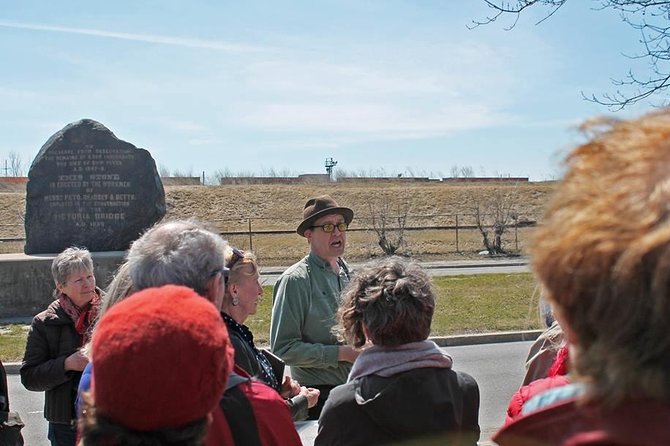
- The Black Rock is the emotional finish: End at the gravesite of more than 6,000 Irish Famine refugees.
- A short, focused tour: The experience lasts about two hours and includes 30 minutes at the Old Port, five minutes at the canal, and 10 minutes at the monument.
- Good value for a history-minded visitor: The price is $20.23, and there are no separate admission fees for the stops.
- Plan for an outdoor walk: The tour requires moderate physical fitness and can be canceled in poor weather.
Why Montreal’s Irish Famine story matters
Montreal is often introduced through its French colonial past, its churches, food, festivals, and handsome old streets. This walk asks you to look at another chapter: the arrival of Irish people fleeing the Great Famine and the deaths that followed.
The subject is not presented as a general city tour. It is narrower and more direct. You follow a route tied to the refugees, their arrival, the mass graves, and the later memorial at Black Rock. That focus is the experience’s greatest strength.
You should come ready for difficult material. This is a memorial walk, not a light sightseeing outing. The tone is likely to be sober because the route ends at a burial site connected to more than 6,000 people. If you want a tour built around architecture, shopping, or cheerful local stories, choose something else.
If you have Irish family connections, the subject may feel especially personal. You do not need that connection to find value in it, though. The walk places a large migration story on specific Montreal streets and waterfront spaces. Instead of treating the Famine as a distant event in Ireland, it shows how its effects reached Canada.
Other walking tours in Montreal:
- The Original Old Montréal Walking Tour by Guidatour
★ 4.5 · 2,217 reviews - Old Montreal Small-Group Walking Tour | Max 10 | by MTL Detours
★ 5.0 · 2,088 reviews - Montréal: The Original Old Montréal Walking Tour
★ 4.8 · 911 reviews
Starting at the Old Port and Place Royale
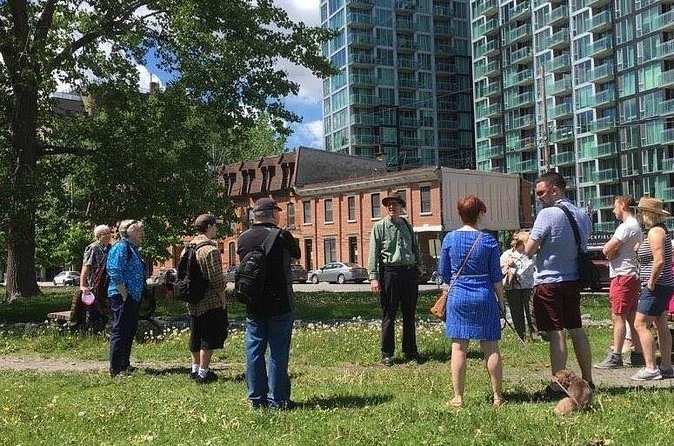
Meet at the Montreal Museum of Archaeology and History, at 350 Place Royale, for the 2:00 pm start. This is a practical meeting point in the Old Port, a part of Montreal that many people visit anyway. You can pair the tour with time in the surrounding area before or after, though the walk itself has a clear historical purpose.
The first stop lasts about 30 minutes. It is the longest part of the route, which makes sense. The Old Port is where your guide can establish the connection between Montreal’s waterfront and the Irish Famine refugees.
You should expect the guide to explain how the refugee story fits into the port’s role. The information supplied for the tour does not name individual guides, so you should not book expecting a particular guide by name. The walk is offered in English.
This opening stop matters because it gives the rest of the tour a starting point. You are not simply shown a memorial at the end with no context. You begin with the place where the wider story connects to Montreal. That structure helps you understand why the later burial sites exist.
The Old Port can also be a busy sightseeing area, so the contrast may be striking. You may be surrounded by one of Montreal’s best-known visitor districts while hearing about people arriving in desperate conditions. The tour uses that familiar setting to point toward a less visible part of the city’s past.
One limitation is the short overall format. Thirty minutes at the opening stop is enough for an introduction, but not enough for a long lecture on Irish history, Canadian immigration, or Montreal’s development. If you already know a lot about the Famine, you may want a more specialized historical program. If the subject is new to you, the focused presentation should be easier to follow.
Finding the mass grave by the Lachine Canal
The second stop is at the Lieu Historique National du Canal-de-Lachine. Your guide shows you the exact location of one of Montreal’s mass graves. The scheduled stop lasts only five minutes.
That timing tells you what this part of the walk is designed to do. You are not spending an hour at a museum or walking through a preserved burial ground. You are being brought to a specific place and shown why it matters. The value comes from location and explanation.
A mass grave can be easy to miss when it is not marked in a way that draws immediate attention. Having a guide identify the site gives the stop a purpose that independent sightseeing may not provide. You may have walked near the canal without realizing what happened there.
The five-minute length may also feel abrupt. It gives the guide time to identify the location and explain its connection to the refugees, but it does not leave much room for an extended discussion. I would treat this as a short but important link between the opening story and the final memorial.
The canal stop also breaks up the route. Instead of moving straight from the Old Port to the Black Rock, the walk shows you another location connected to the deaths. That makes the story less abstract. You encounter more than one place associated with the Famine refugees.
Because the tour requires moderate physical fitness, you should be comfortable with a walking experience that moves between these locations. The supplied details do not give a total distance, number of stairs, or exact walking time between stops. If you have mobility concerns, ask the provider before booking rather than guessing.
Reaching the Black Rock monument
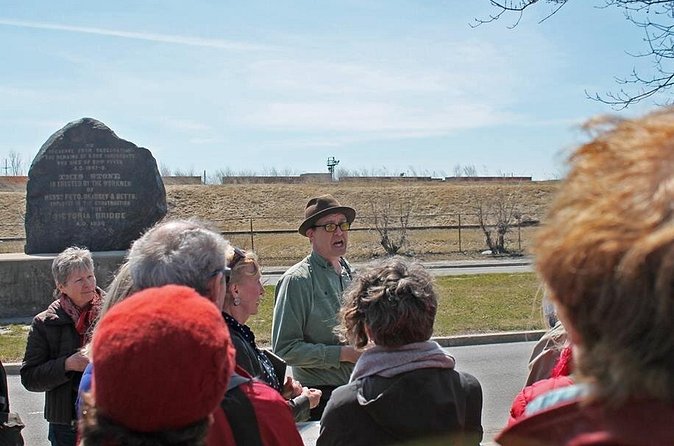
The final stop is the Montreal Irish Monument, commonly called the Black Rock, on Rue Bridge. This is where the tour ends. The monument marks the gravesite of more than 6,000 Irish Famine refugees.
Only 10 minutes are scheduled at the monument, but the stop carries the greatest emotional force. After hearing about the refugees at the Old Port and seeing the mass grave location near the canal, you arrive at the place where the story is memorialized.
The name Black Rock is simple and memorable. The monument does not require a large complex or a long list of attractions to make an impression. Its meaning comes from the people buried there and the history attached to the site.
You may find the ending stark. The tour does not conclude at a café, museum, or central square. It finishes at a gravesite, and that is exactly why the experience feels different from a standard Montreal walk. You are left with a memorial rather than a photo opportunity.
The tour provider can give you directions after the walk. This is useful because the ending is not the same as the starting point. You should plan for the fact that you will finish at Rue Bridge instead of returning to Place Royale. The available information does not specify the best onward route, so ask your guide before you leave.
The short 10-minute stop is the clearest limitation of the itinerary. Some people will want more time at the monument, especially if they have a family connection to Ireland or prefer quiet reflection. Others may appreciate the restrained format. If you need extended time, you can ask whether you may remain at the site after the official tour ends, but that arrangement is not stated as part of the experience.
Other guided walks in Montreal:
- Old Montreal Ghost Walking Tour
★ 4.5 · 726 reviews - The Essential 101 Non-Touristy Walking Tour by Spade & Palacio
★ 5.0 · 716 reviews - Montreal: Top Rated Small Group Old Montreal Walking Tour
★ 4.9 · 611 reviews - Walking tour of Old Montreal – 16/42 Tours
★ 5.0 · 592 reviews
What $20.23 gets you
At $20.23 per person, this is an inexpensive guided history walk. The value comes from the route and the guide’s interpretation, not from admissions or included attractions. All three listed stops are free to enter, so you are paying for the organization, historical explanation, and access to locations that may be easy to overlook.
I think the price works best for someone who wants a short introduction to Montreal’s Irish Famine story. You get a clear beginning, a mass grave location, and a significant memorial in about two hours. That is a reasonable cost for a focused afternoon activity.
It is less useful if you expect a full museum visit or a long, leisurely walking tour. The Old Port receives about 30 minutes, the canal location five minutes, and the Black Rock 10 minutes. The remaining time is used to move through the route and explain the connections.
The group can include up to 40 people. That is a fairly large maximum for a history walk. A smaller group may allow more direct questions and a closer feel with the guide, while a larger group may make it harder to hear or gather around a specific site. The maximum matters if you prefer intimate tours.
The tour is booked an average of 27 days ahead, which suggests that planning early is sensible, especially if your Montreal schedule is fixed. That does not guarantee that every date fills far in advance, but it is a useful sign not to leave this activity until the last minute.
Timing, weather, and practical planning
The tour starts at 2:00 pm and lasts about two hours. That makes it easy to fit into a day of sightseeing, though you should allow extra time to reach the starting point and make your way onward from the Black Rock.
Your meeting point is the Montreal Museum of Archaeology and History at 350 Place Royale. The end point is the Montreal Irish Monument on Rue Bridge, Montreal, Quebec H3K 1X8. Since the tour does not return to the Old Port, avoid leaving anything at the starting point or assuming you will finish near your hotel.
The experience is offered in English and uses a mobile ticket. Confirmation is provided at booking. Service animals are allowed, and the start point is near public transportation.
The walk requires moderate physical fitness. The supplied details do not describe the surface, hills, or exact distance, so you should not assume it is suitable for every mobility level. Wear practical shoes and be prepared to spend time outdoors.
Good weather is required. If conditions make the tour unsafe or unsuitable, the provider may offer another date or a full refund. The tour also requires a minimum number of people. If that minimum is not reached, you may be offered another date or experience, or receive a full refund.
Cancellation is free if you cancel at least 24 hours before the start time. A cancellation made less than 24 hours before the tour is not refunded, and changes within that same period are not accepted. The cut-off uses Montreal local time, so check the clock carefully if you are arranging plans from another time zone.
Who should book this Montreal walk
I would recommend this tour to you if you like place-based history, memorials, and short guided walks that deal with one subject in detail. It is particularly suitable if you want to understand an Irish connection to Montreal that you might not encounter during a standard Old Port visit.
It also suits a visitor with limited time. Two hours is short enough to fit around other plans, and the $20.23 cost keeps the risk low. You can learn something specific without committing to a full-day activity.
Families should decide based on the age and temperament of their children. The topic involves famine, death, refugees, and mass graves. The tour is not presented as a child-focused activity, so younger children may find the material difficult or may not get much from it.
You should think twice if you dislike outdoor walking, need a fully accessible route, or want a large number of sights. The route has only three stops, and the middle and final stops are brief. Its strength is focus, not variety.
The score shown for the experience is 5 out of 5 from 23 ratings, with 100 percent recommending it. That matches the tour’s clear purpose: it brings attention to a part of Montreal’s past that deserves more notice. The strongest praise centers on learning history that many people do not know and on the need for greater attention to Irish heritage in Montreal.
Should you book the Irish Famine in Montreal Walking Tour?
Book it if you want a serious, affordable walk that connects Montreal’s Old Port with the suffering and burial places of Irish Famine refugees. The Black Rock finish and the mass grave near the Lachine Canal give the experience a clear emotional arc.
Skip it if you want entertainment, extensive sightseeing, or a long visit at each stop. This is a compact memorial tour, and its value depends on your interest in difficult history.
For most history-minded visitors, the low price and focused route make it a worthwhile addition to a Montreal stay. Go with comfortable shoes, leave time for the one-way finish at Rue Bridge, and bring the attention this subject deserves.
FAQ
How long does the Irish Famine in Montreal Walking Tour last?
The tour lasts approximately two hours.
What time does the tour begin?
The tour starts at 2:00 pm.
Where does the tour meet?
The meeting point is the Montreal Museum of Archaeology and History at 350 Place Royale, Montréal, Quebec H2Y 3Y5, Canada.
Where does the tour end?
The tour ends at the Montreal Irish Monument, also called the Black Rock, on Rue Bridge in Montreal. Your guide can provide directions at the end.
Is the tour offered in English?
Yes. The experience is offered in English.
How much does the tour cost?
The listed price is $20.23 per person.
Can I cancel for a full refund?
Yes, if you cancel at least 24 hours before the experience start time. Cancellations made less than 24 hours before the start are not refunded. The tour may also be rescheduled or fully refunded if poor weather or an insufficient minimum number of participants causes cancellation.
Just added in Montreal
- Winter Express: Old Montreal Highlights Walking Tour★ 5.0 · 119 reviews
- Under the Surface of Montreal’s Chinatown: Guided Food Walking Tour★ 5.0 · 23 reviews
- Montréal Downtown and Underground City Private Walking Tour★ 5.0 · 47 reviews
- In the Shadow of the Mountain: Montreal Jewish History Walking Tour★ 4.5 · 33 reviews
- Montreal Premium Driving Tour with River Cruise and Notre Dame★ 4.5 · 164 reviews
- Full Day Family Bike Rental★ 5.0 · 17 reviews
- Day at Mont-Tremblant National Park★ 4.0 · 5 reviews
- Toronto, Niagara Falls & Thousand Islands VIP 2–Day Trip★ 5.0 · 20 reviews
Walking Tours, compared.

Old Quebec City: Grand Walking Tour with Private Option
Read our review →
The Original Old Montréal Walking Tour by Guidatour
Read our review →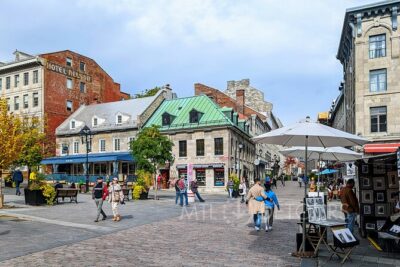
Old Montreal Small-Group Walking Tour | Max 10 | by MTL Detours
Read our review →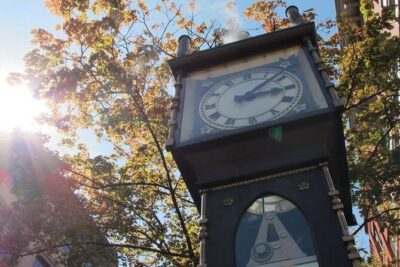
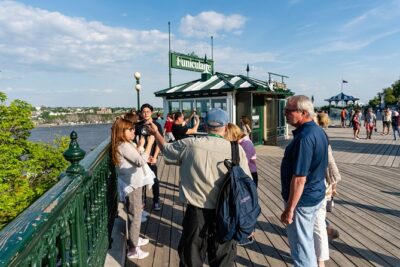
Old Quebec Classique Walking Tour with Funicular
Read our review →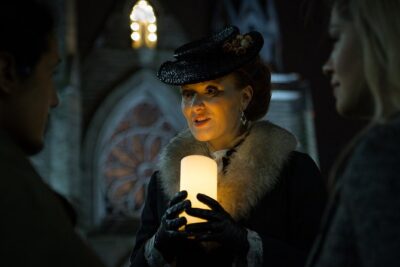

Quebec: Crimes of New France Animated Walking Tour
Read our review →Browse the lists this tour appears in