
Reviewed · WALKING TOURS
Semi-Private Old Montréal Walking Tour by Guidatour
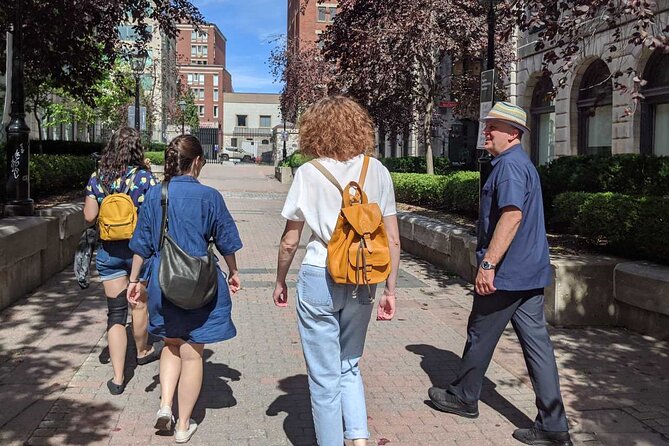
Old Montréal is best understood on foot, one old square and stone façade at a time. This small-group walk takes you from Place d’Youville to Bonsecours Market, with stops at Place Royale, Place d’Armes, Notre-Dame Basilica, and some of the district’s prettiest streets.
I like the maximum of eight people, which gives you a fair chance to ask questions and hear the guide without standing in a crowd. I also like the local advice built into the walk. Guides such as Angie have shared restaurant tips and ideas for the rest of a visitor’s stay. The main caution is that the quality depends heavily on the individual guide, and the route focuses mostly on exterior sights.
Key points at a glance
- Small groups capped at eight: You get a more personal pace than on a large city walk.
- A useful first-morning tour: The 10 a.m. start gives you a strong introduction before you explore Old Montréal on your own.
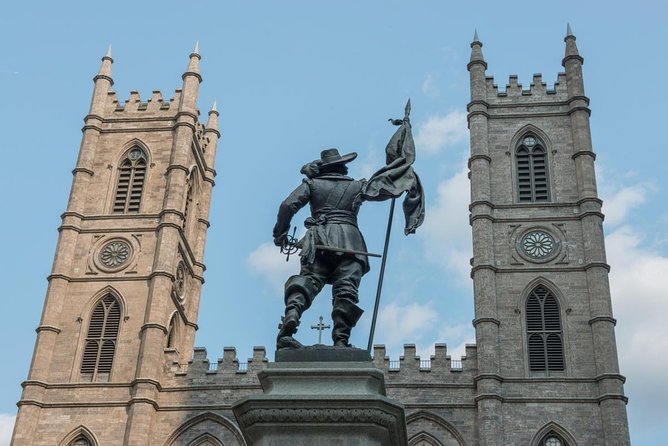
- Historic squares and landmark façades: The route includes Place Royale, Place d’Armes, Notre-Dame Basilica, and Bonsecours Market.
- Guides with different strengths: Past guides include Angie, Gaston, André, Diane, Christian, Sarah, Camille, and Thomas.
- A gentle walking format: The route lasts about two and a half hours and is described as not strenuous.
- Rain or shine: Bring clothing for the forecast, since the tour runs in wet weather as well as clear weather.
Starting at Place d’Youville at 10 a.m.
The meeting point is 214 Place d’Youville, a convenient spot at the western edge of Old Montréal. You begin at 10 a.m., a useful time for seeing the district before committing the rest of your day to museums, shopping, food, or the Old Port.
This is a walking tour, so wear comfortable shoes and dress for the day. The company runs the experience rain or shine. One guide, Angie, handled a sudden rainstorm by moving the group under cover and continuing the stories until the weather eased. That sort of flexibility matters in Montréal, where a pleasant morning can change quickly.
The tour is offered in English and includes a mobile ticket. The meeting point is near public transportation, and most people can take part. Service animals are allowed. The route ends at Bonsecours Market, at 350 Rue Saint-Paul East, so you do not finish where you started. That is handy if you plan to continue east through Old Montréal afterward.
Other walking tours in Montreal:
- The Original Old Montréal Walking Tour by Guidatour
★ 4.5 · 2,217 reviews - Old Montreal Small-Group Walking Tour | Max 10 | by MTL Detours
★ 5.0 · 2,088 reviews - Montréal: The Original Old Montréal Walking Tour
★ 4.8 · 911 reviews
Place Royale and the first layers of Montréal
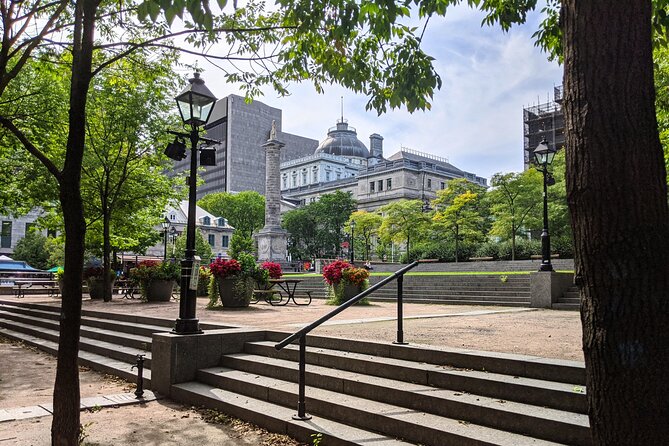
Place Royale is a fitting place to begin the storytelling. This historic square has served as a market area and a setting for official business, giving your guide a natural way to explain how Montréal developed from a small colonial settlement into a major city.
The value here is not simply seeing an old square. A guide can connect the paving stones, building fronts, and public space to the people who used them. Plaques and signs give you dates and names, but the guide can explain why the place mattered and how its role changed.
Expect to stop often for photographs. That is one of the strengths of this format. You are not being pushed from one sight to another on a strict march. A small group can pause, look up at details, and ask a question without holding up dozens of people.
Place Royale also helps you get your bearings. From here, the route moves across the historic district toward Place d’Armes, giving you a clear sense of how the western and eastern parts of Old Montréal connect.
Walking toward Place d’Armes
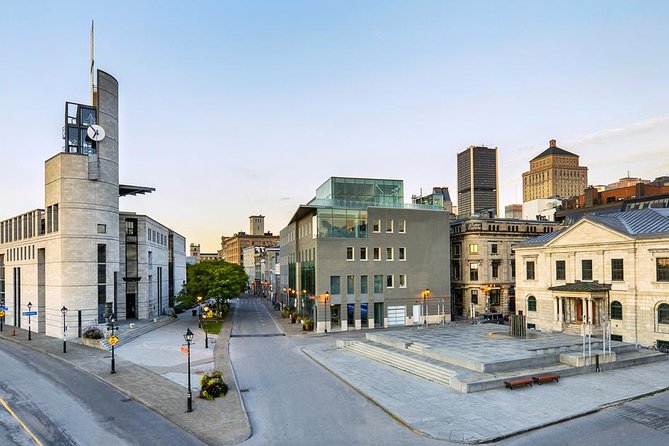
The walk between Place Royale and Place d’Armes is not filler. It gives the guide room to explain the old borough as a working part of the city rather than a collection of isolated monuments.
This section is especially useful if you are new to Montréal. You begin to recognize the scale of Old Montréal, the pattern of its streets, and the way older stone buildings sit beside later additions. Several past tours have included explanations of architecture, city life, and modern Québec culture, not only dates from a textbook.
The route can also be adjusted in feel by the person leading it. Carol, for example, was praised for shaping the discussion around an interest in history. Camille brought a more relaxed pace with humor and conversation. Thomas added fun facts and anecdotes, while Christian mixed formal history with everyday details about life in the district.
That variation is worth keeping in mind. The company promises official city-certified guides, but no two guides tell a city in exactly the same way. If you like asking questions, the eight-person limit gives you a good chance to guide part of the conversation toward architecture, politics, religion, food, or daily life.
Place d’Armes and the face of Notre-Dame Basilica
Place d’Armes is one of the tour’s major visual stops. It brings together several layers of Montréal architecture and provides a strong setting for discussing the city’s public life.
From here, you admire the exterior of Notre-Dame Basilica. The basilica is one of Old Montréal’s best-known landmarks, but this experience is not presented as a dedicated interior visit. The focus is the façade, the surrounding square, and the story your guide attaches to the setting.
That distinction matters when you compare this walk with a church tour. If you mainly want to see the basilica’s interior, check the plan before booking and consider arranging that separately. The walking tour gives you context and a chance to study the building from outside, but most of the route is built around streets and exteriors.
The stop is still valuable because the guide can point out details you might pass without noticing. One recurring strength of this experience is the explanation behind plaques and buildings. You get more than a list of dates, and you can ask about what you are looking at rather than trying to read every sign on your own.
Other guided walks in Montreal:
- Old Montreal Ghost Walking Tour
★ 4.5 · 726 reviews - The Essential 101 Non-Touristy Walking Tour by Spade & Palacio
★ 5.0 · 716 reviews - Montreal: Top Rated Small Group Old Montreal Walking Tour
★ 4.9 · 611 reviews - Walking tour of Old Montreal – 16/42 Tours
★ 5.0 · 592 reviews
Montréal’s most picturesque street
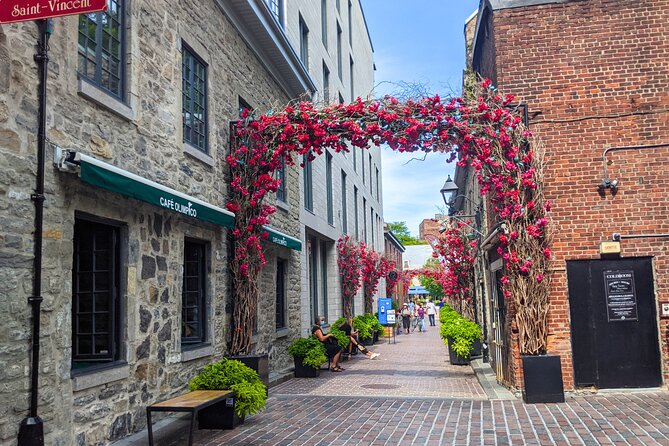
The route includes a stroll down what is described as the single most picturesque street in Montréal. The exact appeal is easy to understand: Old Montréal’s narrow historic streets offer strong photo opportunities, with stone buildings, restored façades, and a sense of scale that differs from the newer parts of the city.
This is likely one of the walk’s most enjoyable stretches for people who want photographs without making the entire tour a photo shoot. The guide provides the setting and background, while you have repeated chances to stop and frame the details.
There is a practical tradeoff. Streets in the old district can be uneven, and you will be on your feet for much of the morning. The tour is described as not strenuous, but that does not mean it is a seated sightseeing experience. Comfortable footwear remains the sensible choice.
A plaza filled with statues and monuments
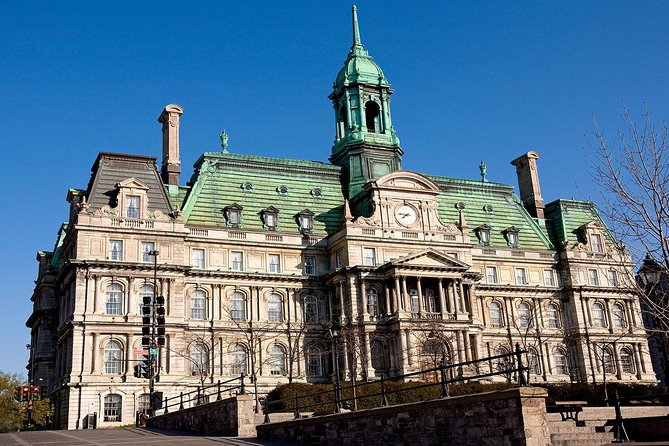
Another stop brings you to a famous plaza with statues and monuments. This part of the route adds a public-art and civic layer to the tour.
Monuments make more sense when someone explains who is represented, what the figures meant at the time, and how the city remembers its past. You may find that this is where a good guide makes the biggest difference. A short description can make a statue easy to forget. A story about the person or event behind it can turn the same object into a useful piece of Montréal’s story.
Past guides have been praised for answering questions and keeping the group involved. Diane was described as warm and engaging, while André was noted for combining history, culture, and present-day Montréal. Those are useful qualities on a stop like this, where the meaning is less obvious than the architecture.
Cours Le Royer and the old Hôtel-Dieu grounds
Cours Le Royer offers one of the route’s quieter changes of pace. This charming passage is lined with restored 19th-century warehouses and streets connected to the former Hôtel-Dieu grounds.
The setting helps you see how Old Montréal has been reused over time. These were not buildings created simply to look historic for visitors. They had practical roles tied to commerce, institutions, and the daily work of the city. A guide can help you read those changes in the walls, doors, windows, and arrangement of the buildings.
This is also a good place to slow down. The route is not only about famous landmarks. Smaller courtyards and passages often give you a better feel for the district than a quick stop at a well-known façade. Cours Le Royer supplies that quieter visual break before the final section near the riverfront side of Old Montréal.
Bonsecours Market and the final stop
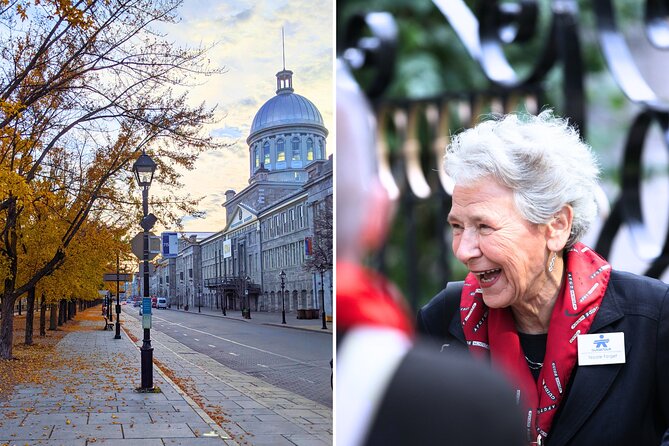
The tour finishes at Bonsecours Market, a grand 19th-century building that once served as a center of Montréal commerce and politics. Its large exterior gives the walk a strong ending and a clear point from which to continue exploring.
Bonsecours Market is more than a pretty building. Its past connects trade, public life, and the growth of the old district. The guide’s explanation helps you understand why this location mattered, rather than treating it as a final photo stop.
Ending here is practical. You can continue along Rue Saint-Paul, explore nearby streets, or make your own plans in the eastern part of Old Montréal. Since the tour begins at Place d’Youville, the route also gives you a useful west-to-east introduction to the borough.
The experience has sometimes included access to the inside of buildings, but you should not assume that every departure will do so. One tour included interiors that the group might not have entered alone, while another described the walk as mostly exterior stops with three interiors. Treat that as guide and day dependent.
What the small group changes
The group limit is eight people, and that is the feature that most affects the feel of the morning. You are not trying to hear a guide across a wide circle of people. The guide can keep the group together through narrow streets and respond to questions without losing the thread.
A small group also makes the pace more relaxed. One past group found that the format allowed conversation and an easy rhythm. Another had only two people on the tour, which created an almost private experience.
Still, semi-private does not mean private. You may share the walk with other people, and the exact group size can vary up to the stated maximum. If you need a completely custom route or guaranteed one-on-one attention, ask about a private tour instead.
The small size is especially useful for families and couples. Sarah once accommodated a participant who felt unwell by finding a place to sit and getting cold water. That does not turn the tour into a medical service, but it does show why a compact group can be easier to manage than a large one.
The guides make or break the morning
Guidatour identifies its leaders as official city-certified guides. The strongest guide accounts describe people who were lively, warm, and able to answer questions without making the walk feel like a lecture.
Names associated with the experience include Angie, Gaston, Louie, André, Diane, Laura, Thomas, Sarah, Christian, Camille, Carol, Caroline, and Louis Bouchard. Angie is especially useful for practical planning because she has offered food suggestions and ideas for the rest of a stay. Gaston and André have been praised for making architecture and history easy to follow. Christian was noted for adding everyday details beyond formal historical facts.
The less successful experiences point to the main risk. One participant found the guide too brief and disengaged, while another felt too much time was spent looking at banks. Those complaints are not a reason to dismiss the tour, but they are a reminder that guide quality and route emphasis matter.
If you book, take an active role. Ask about the buildings you pass. Tell the guide if you are more interested in architecture, religion, politics, food, or modern Québec. The small group gives you room to do that.
Is $52.57 a fair price?
At $52.57 per person, this is not the cheapest way to see Old Montréal. You can walk the streets without paying anything, and you can read plaques or use a guidebook at your own pace.
The fee makes more sense if you value interpretation, company, and a planned route. You receive roughly two and a half hours with a certified local guide, a group capped at eight, and a route that covers several of the district’s key spaces. Local taxes are already included, so the advertised price is not padded with a surprise tax at checkout.
I see the best value for a first morning in Montréal. You get an overview of the district, learn which streets and buildings deserve a second look, and can ask for restaurant or sightseeing ideas. The walk also helps you avoid spending your first day wandering without context.
The value drops if you want long interior visits, a food tour, or a highly specialized architectural lecture. It also drops if your guide gives only short comments at each stop. For most people, though, the small group and practical orientation justify the cost better than a large sightseeing circuit would.
Who should book this Old Montréal walk?
I would choose this tour if you are visiting Montréal for the first time, want a human introduction to the old district, and prefer walking to riding around in a vehicle.
It suits:
- Couples who want a relaxed start to a city break
- Families that benefit from a manageable group size
- History fans who like asking questions
- Visitors who want restaurant and sightseeing suggestions
- People who prefer exterior architecture, squares, and street scenes
- Anyone who wants to explore Old Montréal early in a visit
You may want another option if your main goal is the interior of Notre-Dame Basilica, a food-focused outing, or a fully private itinerary. Also think carefully about weather and footwear. The tour runs in rain, and the walking surface is the street, not a polished museum floor.
Free cancellation is available if you cancel at least 24 hours before the 10 a.m. start. Changes or cancellations inside that window are not accepted for a refund, and a minimum group requirement applies. That policy is worth noting before you make firm plans.
My verdict on the Guidatour experience
I would book this as an opening activity in Montréal, especially if you have not explored Old Montréal before. The route covers the right kind of places: historic squares, a major basilica exterior, a picturesque street, restored warehouses, monuments, and Bonsecours Market.
The strongest reasons to choose it are the eight-person limit, the certified local guides, and the practical advice that can shape the rest of your visit. The main reservation is the guide-dependent quality and the fact that the walk is mostly outdoors.
Book it if you want stories and context while you walk. Skip it if you only want entrance tickets or a rigid, specialist itinerary. For a first look at Old Montréal, the balance of time, price, and personal attention is solid.
FAQ
How long does the Old Montréal walking tour last?
The tour lasts approximately two and a half hours.
What time and where does the tour begin?
It begins at 10 a.m. at 214 Place d’Youville, Montréal, Québec H2Y 2B4.
Where does the tour finish?
The walk ends at Bonsecours Market, 350 Rue Saint-Paul East, Montréal, Québec H2Y 1H2.
How large is the group?
The group has a maximum of eight people.
Is the tour offered in English?
Yes. The experience is offered in English.
What happens if it rains?
The tour runs rain or shine. Dress for the weather and wear comfortable shoes.
Just added in Montreal
- Winter Express: Old Montreal Highlights Walking Tour★ 5.0 · 119 reviews
- Under the Surface of Montreal’s Chinatown: Guided Food Walking Tour★ 5.0 · 23 reviews
- Montréal Downtown and Underground City Private Walking Tour★ 5.0 · 47 reviews
- In the Shadow of the Mountain: Montreal Jewish History Walking Tour★ 4.5 · 33 reviews
- Montreal Premium Driving Tour with River Cruise and Notre Dame★ 4.5 · 164 reviews
- Full Day Family Bike Rental★ 5.0 · 17 reviews
- The Ultimate Montreal Boat Tour – Fall Colors Apéro Edition★ 4.5 · 31 reviews
- Day at Mont-Tremblant National Park★ 4.0 · 5 reviews
Walking Tours, compared.
Old Quebec City: Grand Walking Tour with Private Option
Read our review →
The Original Old Montréal Walking Tour by Guidatour
Read our review →
Old Montreal Small-Group Walking Tour | Max 10 | by MTL Detours
Read our review →
Old Quebec Classique Walking Tour with Funicular
Read our review →

Quebec: Crimes of New France Animated Walking Tour
Read our review →Browse the lists this tour appears in