

Reviewed · WILDLIFE & BEAR TOURS
Sights of Moose Jaw Smartphone Audio Walking Tour
Moose Jaw’s story gets wonderfully odd once you connect its old railway yards, mineral spa, murals, churches, and Prohibition-era legends. This self-guided smartphone walk lets you follow those threads without keeping pace with a group or waiting for a guide.
I like the live GPS map, which shows where you are and where to go next, and I like the freedom to pause at a café, building, or attraction. The optional trivia is a nice touch, too. The main drawback is practical: your phone battery matters, and the full route may take longer than the advertised one to two hours if you stop to look around.
Key points at a glance
- More than 30 downtown sights: See churches, murals, public buildings, railway sites, parks, and theaters on one walk.
- Automatic audio near each stop: Commentary begins as you approach a location, with no mobile signal needed after downloading.
- Moose Jaw’s stranger stories: Hear about bootlegging, Al Capone lore, geothermal water, haunted dining, and a famous mermaid.
- A flexible private experience: Stop and start anywhere, and use the tour on any date after booking.
- Good value at $6.71: You get a guided route and local context for less than the price of many paid attractions.
- Bring a charged phone: The audio and GPS map use your device throughout the walk.
A low-cost way to meet Moose Jaw
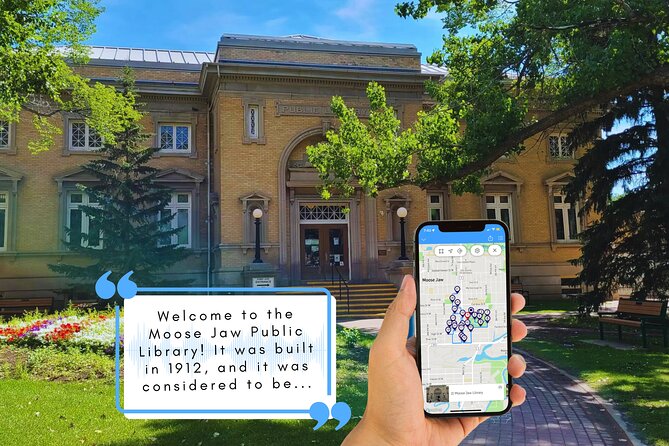
At $6.71 per person, this is priced more like a useful city guide than a formal tour. You are paying for the route, narration, map, and trivia rather than for entry into attractions. That distinction matters because the Tunnels of Moose Jaw and any other paid sites are not included.
The tour begins at Crescent Park on Langdon Crescent and ends at the Latimer Residence at 37 Oxford Street West. It is a private activity for your group, so you do not share the pace or conversation with strangers. You can also keep the tour and use it at a later time, rather than being tied to the original booking date.
I see the best value here for someone who wants more than a quick walk down Main Street but does not need a live guide beside them. The narration gives you a reason to look up at a building, read a mural, or pause beside a memorial instead of simply passing by.
The tradeoff is that a phone tour asks you to manage a few things yourself. Download the content on Wi-Fi before leaving, charge your phone fully, and bring headphones if you prefer private listening. The audio also plays through the device speaker, so headphones are optional.
Other wildlife trips out of Canada:
- Victoria Whale and Wildlife Cruise
★ 5.0 · 1,729 reviews - Banff Highlights & Wildlife | Award-Winning Small Group Adventure
★ 4.5 · 725 reviews - Jasper Evening Wildlife Tour
★ 4.5 · 710 reviews
Crescent Park sets the tone
The first part of the route uses Crescent Park to introduce Moose Jaw through public spaces and civic memory. You begin at the Moose Jaw Public Library, then continue to the park’s amphitheatre, murals, cenotaph, fountain, and waterfalls.
The Crescent Park Amphitheatre comes with a story about how it took shape in 1972. The nearby painted murals add visual interest, so this is not a route made up only of plaques and facades. You can pause to study the artwork while the audio provides context.
At the Crescent Park Cenotaph, the focus shifts to military remembrance. The memorial, also called the Cross of Sacrifice, was designed by Reginald Bloomfield and built by the Moose Jaw Marble and Granite Company in 1923. It was unveiled during the first Armistice Day ceremony.
The park fountain and waterfalls give this opening stretch a lighter change of pace. You are not being rushed from one indoor display to another. The route uses the park itself as part of the experience, which makes the first section easy to combine with a relaxed walk.
Railways, tennis, and the Moose Jaw Mermaid
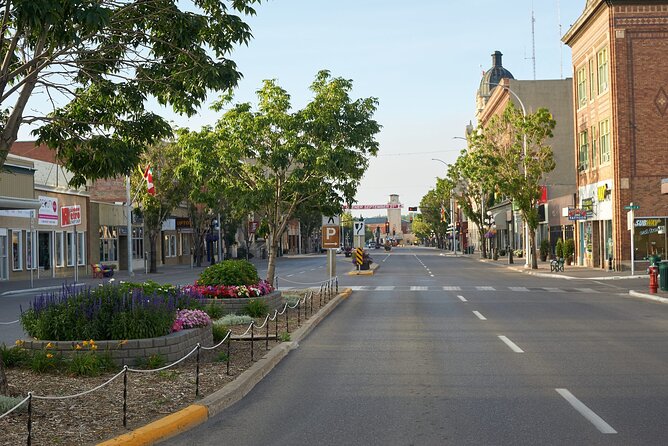
The old Canadian National Railway station is one of the early stops, and the narration explains its design and past. That matters because railways shaped the city’s movement, commerce, and later stories about liquor running through town.
The Crescent Park Tennis Club provides a more unexpected stop. The audio explains the courts’ claim to fame, giving you one of those small local details that would be easy to miss on a standard sightseeing walk.
Next comes the Moose Jaw Natatorium at the Phyllis Dewar Outdoor Pool. Here you hear about the famous Moose Jaw Mermaid. The subject adds a bit of local character to the route and breaks up the run of formal buildings and memorials.
These stops also show why the tour works best when you allow extra time. The audio clips may be short, often listed at about five minutes, but you still need walking time between locations and a moment to take in each place.
Mineral water and churches with unusual pasts
At Temple Gardens Hotel and Spa, the tour explains how Moose Jaw’s natural geothermal mineral waters were discovered by accident in 1910. You do not need to enter the spa to understand why it matters to the city, though any admission or treatment is separate from the walking tour.
The route then visits St. Mark’s Presbyterian Church, where the story centers on the building’s unusual past and its occupants over the years. St. Aidan Anglican Church follows, with its Gothic Revival design dating from 1909.
These church stops are valuable for readers who enjoy architecture but do not want a formal architectural lecture. You get a short explanation at the spot itself, then move on before the information becomes heavy. The audio format also lets you replay a section if you are standing across the street or distracted by nearby activity.
A nearby house now used as a political office adds another layer. The stop explains the building’s changing purpose over time, a useful reminder that old structures often survive by taking on new roles.
Other guided walks in Canada:
- Quebec City Walking Tour
★ 5.0 · 4,716 reviews - Old Quebec City: Grand Walking Tour with Private Option
★ 4.8 · 2,609 reviews - The Original Old Montréal Walking Tour by Guidatour
★ 4.5 · 2,217 reviews - Old Montreal Small-Group Walking Tour | Max 10 | by MTL Detours
★ 5.0 · 2,088 reviews
Prohibition stories near the rail yard

Moose Jaw’s connection to Prohibition is one of the route’s most colorful themes. At the CPKC Rail Moose Jaw Yard, you hear how the station served as a funnel for bootleg liquor during Prohibition and about its ironic future.
The Tunnels of Moose Jaw continues that subject with stories linked to Al Capone and underground activity. The audio has a playful tone here, but the practical point is important: admission to the Tunnels is not included. If you want to visit inside, plan and pay for that separately.
This is one of the strongest parts of the walk for anyone who likes stories that connect a place to a wider period in North American history. The railway yard and tunnels are not presented as isolated sights. They fit into a larger tale about transport, smuggling, and Moose Jaw’s reputation.
Keep your expectations measured. The smartphone tour can explain the setting and point you toward the attraction, but it does not replace a ticketed visit inside the Tunnels. Think of it as a useful introduction, not the full attraction.
City Hall, Zion Church, and old department stores
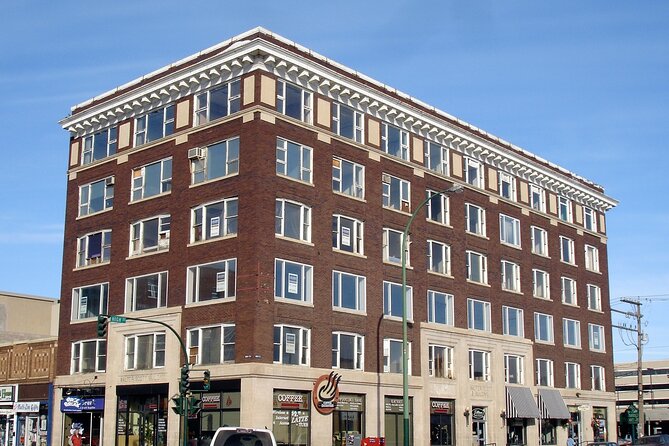
Moose Jaw City Hall brings the route back to civic architecture. The audio connects the stone-colored building with fossils, an unusual detail that gives you something specific to remember beyond its exterior.
Zion United Church is another imposing building with a historic fact attached to it. The tour then moves to the Eaton’s building, once home to one of Canada’s best-known department stores.
The sequence works well because it shows different sides of downtown life. City Hall represents public administration, Zion United Church represents community and faith, and Eaton’s points to retail and everyday shopping. You get a better sense of how the center functioned, rather than seeing a collection of unrelated old buildings.
At the Capital Theatre, also known as the Mae Wilson Theatre, the audio turns to theatrical and performing arts history. This heritage building helps explain why downtown Moose Jaw was not only a place to work and shop, but also a place to gather for entertainment.
Main Street buildings and Mosaic Place
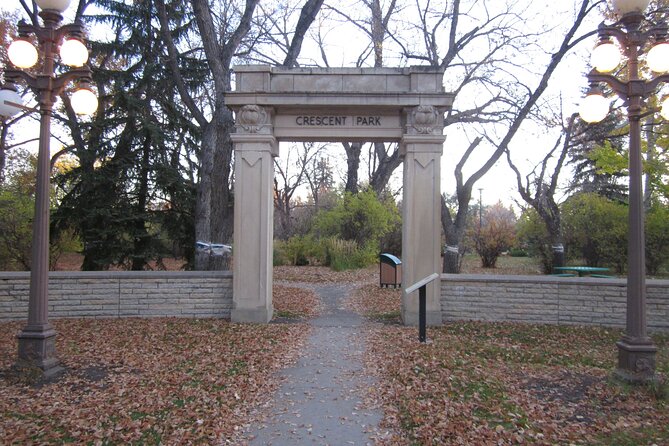
The Moose Jaw Cultural Centre includes an Army and Navy store stop, where the focus is the building’s contribution to the streetscape. The Walter Scott Building follows, with a story about its purpose when it was built and what Walter Scott himself may have said about it.
Mosaic Place changes the mood again. The arena has hosted sporting events, music, and performances, so the stop connects older downtown buildings with a more modern public venue.
I like this part because it avoids treating preservation as something frozen in time. The walk moves from historic commercial buildings to an active arena, showing how the city continues to use shared public spaces for entertainment and events.
The audio clips are short enough to keep you moving, but you can stop for longer if a building catches your eye. That flexibility is a real advantage over a tightly scheduled group walk.
Murals that explain Saskatchewan stories
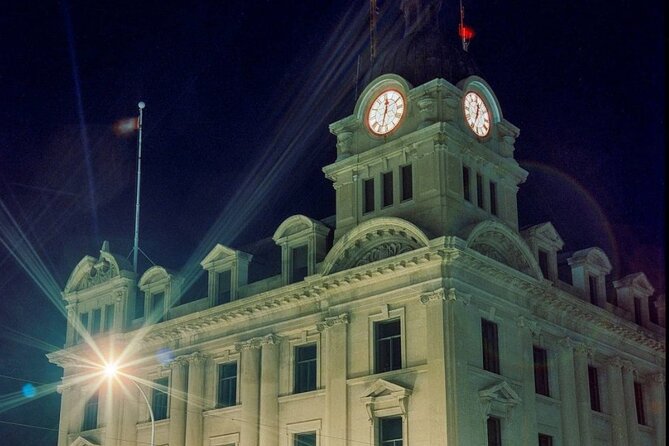
Moose Jaw has many murals, and the tour uses them as more than decoration. At the Breaking New Ground mural, you hear how the artwork shows the process of gaining land ownership in Saskatchewan.
Another mural presents Louis Riel, a Métis leader associated with the North-West Rebellion. The stop provides a direct link between public art and regional history. You are not just looking at painted walls. You are being shown how Moose Jaw uses outdoor art to tell stories that might not fit neatly onto a building plaque.
The tour also points out several other murals along the way. That makes the route rewarding for people who like street art and gives you a reason to keep looking above storefront level.
The audio can identify the main themes, but you will still need to look carefully at the murals yourself. The experience is strongest when you pause, examine the details, and let the commentary guide your attention rather than walking with your eyes fixed on the map.
Land titles, fire, and the courthouse
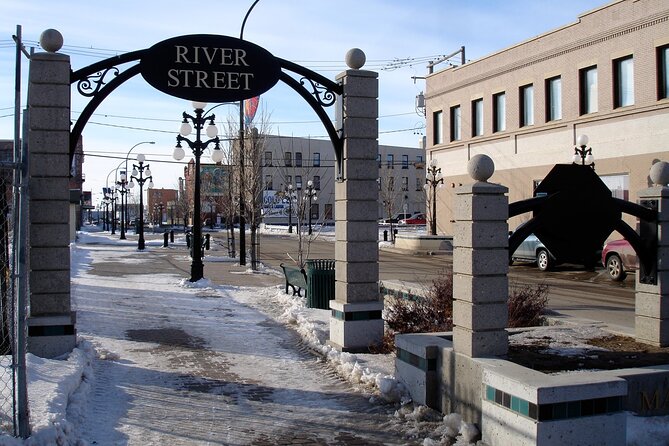
The Land Titles Building, built in 1910, played an important role in transferring land titles in the region at the turn of the century. It is a good stop for understanding the administrative systems behind settlement and land ownership.
The Old Fire Hall adds a practical civic story, while the Moose Jaw Courthouse brings you to a National Historic Site. The audio explains the courthouse’s distinction and gives the building a place within the city’s larger public history.
This group of stops has less of the colorful folklore found around the tunnels, but it is important for balance. You see how government, records, law, and emergency services shaped the city. The tour does not rely only on tales of bootleggers and ghosts.
Hauntings, schools, and the Latimer Residence
Hopkins Dining Parlour is presented as one of Saskatchewan’s most haunted places. The audio tells you who is said to haunt it, giving the route one final dose of mystery.
Central Collegiate Institute, more than 110 years old, is one of Saskatchewan’s oldest operating public schools. The stop includes information about famous people it has hosted. This is a useful reminder that local history often lives in ordinary institutions, not just grand monuments.
The final featured stop is the Latimer Residence at 37 Oxford Street West. It is a two-and-a-half-story, brick-clad house completed in 1905, set on a tree-lined street beside homes of a similar age and scale. The house has retained many of its original features and provides a quieter ending after the busier downtown sights.
The ending is not at a major attraction or visitor center. That is worth knowing before you start. The route finishes at a residential historic house, so you may want to plan what you will do next rather than expecting a final indoor stop.
How the GPS audio system works
The tour uses your smartphone as both map and guide. After you download it on Wi-Fi, the live GPS map shows your location and the next place to go. As you approach a stop, the commentary plays automatically.
That system is simple, but it changes how you walk. You do not need to keep checking written directions every minute, and you can focus on the streets and buildings around you. If you miss a detail, you can stop and listen again.
The trivia questions appear after the commentary at each location. They are optional, so you can treat them as a light game or ignore them and keep walking. I think the questions are most useful for families or groups who want a little interaction without turning the outing into a formal activity.
The biggest technical concern is battery life. A phone that runs GPS and audio for the route can lose power before you reach the end, so start with a full charge. The device count also matters: the number of people selected when booking equals the number of devices allowed to download the tour.
Timing, access, and who will like it
The stated duration is about one to two hours, but that is best viewed as a rough walking estimate. With more than 30 sites, short audio segments, photo stops, mural viewing, and time spent at the park, you may want longer.
The tour is offered in English. Service animals are allowed, and it is near public transportation. Most people can participate, though the supplied details do not provide a full route assessment for every mobility need.
Free cancellation is available up to 24 hours before the start time. Changes or cancellations inside that window are not refunded, so keep the local cut-off time in mind.
I would choose this tour if you:
- Want a private walk without a fixed group schedule
- Like local stories, murals, public buildings, and old railway connections
- Prefer using your own phone rather than meeting a live guide
- Want to stop for food, shopping, or extra sightseeing along the route
- Are comfortable managing GPS, audio, and battery power
I would choose another option if you want a guide who can answer questions in real time, or if you mainly want admission to the Tunnels of Moose Jaw. This experience points you toward attractions but does not cover their tickets.
Should you book the Moose Jaw walk?
For $6.71, this is an easy value choice for a self-guided introduction to Moose Jaw. I especially like the mix of Crescent Park, railway stories, geothermal water, churches, murals, theaters, civic buildings, and Prohibition lore. You get more context than you would from wandering alone, but far more freedom than you would have on a group tour.
Book it if you want to explore at your own speed and are willing to keep your phone charged. Download it on Wi-Fi, begin at Crescent Park, leave time for the murals and buildings, and budget separately for the Tunnels if you plan to go inside. If that setup suits you, the tour offers a smart, inexpensive way to get oriented in Moose Jaw.
FAQ
How much does the Sights of Moose Jaw Smartphone Audio Walking Tour cost?
The tour costs $6.71 per person.
How long does the tour take?
The estimated duration is about one to two hours, though you can take as long as you like because the tour has no time limit.
Where does the tour begin?
It begins at Crescent Park on Langdon Crescent in Moose Jaw, Saskatchewan.
Where does the tour end?
The route ends at the Latimer Residence, 37 Oxford Street West, Moose Jaw.
Is the tour guided by a live person?
No. It is a smartphone audio tour with GPS-triggered commentary.
Do I need mobile data during the walk?
No. You can download the tour on Wi-Fi before starting, and no signal or mobile data is required during the tour.
What devices can be used for the tour?
You need a smartphone or tablet. The number of travelers selected when booking equals the number of devices that can download the tour.
Are headphones required?
No. Headphones are optional because the audio can play through your device speaker.
Is admission to the Tunnels of Moose Jaw included?
No. Attraction tickets are not included, including admission to the Tunnels of Moose Jaw.
Can I cancel for a full refund?
Yes. You can cancel at least 24 hours before the experience start time for a full refund. Cancellations or changes made less than 24 hours before the start time are not accepted or refunded.
Just added in Canada
- 2-Hour Two Castle 1000 Islands Cruise from Ivy Lea★ 4.5 · 24 reviews
- Medway Lakes Canoe Trip 3-Day★ 5.0 · 12 reviews
- Meet The Seals Boat Tour – Travel by boat to a Secret Seal Cove★ 5.0 · 21 reviews
- 20 Minute Scenic Helicopter Private Tour★ 5.0 · 14 reviews
- Wine, Cheese, Chocolate 6 Hour Tasting Tour with Lunch★ 5.0 · 45 reviews
- Wine Tour with Lunch in Niagara-on-the-Lake★ 5.0 · 25 reviews
- Guided Craft Cider Tour in Niagara★ 4.5 · 4 reviews
- Walking Food Tour in Niagara Falls★ 5.0 · 6 reviews
Wildlife & Bear Tours, compared.


Banff Highlights & Wildlife | Award-Winning Small Group Adventure
Read our review →

Jasper National Park: Evening or Morning Wildlife Watch Tour
Read our review →
Jasper Wildlife & Sightseeing Tour with Maligne Lake Cruise
Read our review →
Wildlife and Waterfalls Tour with Maligne Cruise
Read our review →

Cowichan Bay Half Day Whale & Wildlife Adventure
Read our review →Browse the lists this tour appears in